
Here’s something that shocked me: a single dedicated machine can outperform 50 graphics cards while using less power. That’s the efficiency gap we’re talking about in 2024.
I’ve been running operations since 2017. I’ve seen both sides of this hardware debate firsthand. Started with a basement full of rigs, then watched commercial farms operate with specialized equipment.
This isn’t your typical spec-sheet comparison. We’re diving into real profitability numbers, actual electricity costs, and technical considerations that matter. These factors become crucial when you’re putting money on the line.
You might be setting up in your garage or planning something bigger. The choice between these two approaches affects everything. Your upfront investment, monthly utility bills, and long-term flexibility all depend on this decision.
Each technology delivers different results. Understanding these differences helps you make smarter choices.
I’ve burned through hardware and made costly mistakes. This guide gives you the unfiltered truth about both options. It’s based on hands-on experience and current market realities.
Key Takeaways
- Specialized machines deliver 50x better hash rates than traditional graphics cards for the same power consumption
- Initial equipment costs differ dramatically, with dedicated hardware requiring $2,000-$15,000 versus $300-$1,500 per card
- Flexibility matters—graphics cards can switch between different coins while specialized machines lock you into specific algorithms
- Power efficiency directly impacts profitability, and dedicated hardware typically uses 40-60% less electricity per hash
- Resale value varies significantly, with graphics cards maintaining broader market appeal beyond cryptocurrency applications
- Setup complexity and maintenance requirements differ substantially between the two hardware approaches
- Your location’s electricity rates can make or break profitability regardless of which hardware you choose
Overview of Bitcoin Mining
Bitcoin mining uses real hardware to crunch real numbers. The equipment you choose impacts your ability to compete in this global race. Understanding Bitcoin hardware mining fundamentals helps you decide between ASICs and GPUs.
Before comparing mining technologies, you need to understand what mining accomplishes. It’s not just about earning Bitcoin. It’s the engine that keeps the entire network running.
What Mining Actually Does
Mining runs specialized hardware that performs SHA-256 hash calculations. Your equipment competes with miners worldwide to solve a cryptographic puzzle. This puzzle validates the next block of transactions.
Your mining hardware receives newly minted Bitcoin plus transaction fees when it finds the correct solution first. That’s proof-of-work in action. Computational effort converts into network consensus.
Each calculation is like buying a lottery ticket. You’re buying billions of tickets per second. More calculations mean better odds of solving the block first.
Modern Bitcoin hardware mining operations have evolved into sophisticated setups. You’re managing power consumption and cooling systems. You’re constantly monitoring hash power output to stay competitive.
Why Mining Matters to Bitcoin’s Survival
Without miners, Bitcoin doesn’t function. The mining process serves three critical functions. Most people overlook these when focused solely on profitability:
- Network Security: Miners protect Bitcoin against attacks by contributing computational power. You’d need to control 51% of the total hash power to manipulate transactions—an economically impractical feat with today’s mining scale.
- Transaction Processing: Every Bitcoin transaction requires validation and inclusion in a block. Miners process and verify these transactions without any central authority controlling the system.
- Supply Control: Mining regulates Bitcoin’s issuance through a predictable schedule. The block reward halves approximately every four years, creating scarcity that’s written into the protocol itself.
The hardware you choose determines your role in this ecosystem. ASIC miners dominate Bitcoin’s network today. They contribute the vast majority of hash power.
ASIC miners are purpose-built machines designed exclusively for Bitcoin’s SHA-256 algorithm. They offer unmatched efficiency for Bitcoin mining. No other hardware type can match their performance.
GPU mining has largely migrated to other cryptocurrencies. Graphics cards offer flexibility. They can’t compete with ASICs for Bitcoin mining efficiency.
GPUs aren’t obsolete—they’ve found their niche elsewhere. They work well for mining altcoins. Bitcoin mining, however, belongs to ASICs.
Understanding this context is essential before comparing these technologies. The Bitcoin mining landscape has evolved dramatically. Today’s Bitcoin hardware mining decisions require weighing multiple factors.
You must consider hash rate, energy consumption, and long-term profitability. The difficulty level keeps increasing. These factors determine your mining success.
The shift from GPU to ASIC dominance wasn’t just about raw performance. It fundamentally changed who can participate profitably in Bitcoin mining. It also changed how the network maintains its security model.
ASIC Miners: An In-Depth Look
I’ve spent years working with various mining hardware. Nothing compares to the raw efficiency of purpose-built ASICs. These machines have completely changed the Bitcoin mining landscape.
They’re not versatile, and they’re not flexible. But they’re devastatingly effective at what they do.
Understanding ASIC miners for cryptocurrency requires looking beyond simple specifications. You need to grasp why they dominate Bitcoin mining. You also need to know what makes them different from every other computing device.
Understanding Application-Specific Integrated Circuits
ASIC stands for Application-Specific Integrated Circuit. That’s a fancy way of saying hardware designed for exactly one purpose. For Bitcoin, that purpose is SHA-256 hashing and absolutely nothing else.
Unlike the processor in your computer, every transistor in an ASIC is optimized. It focuses on this one algorithm. There’s zero wasted silicon and zero unnecessary features.
Think of it this way: a GPU is like a Swiss Army knife. It’s useful for many tasks but not perfect at any single one. An ASIC is like a surgical scalpel—useless for everything except its precise job.
For Bitcoin mining, you want the scalpel. The evolution I’ve witnessed has been remarkable. Each generation brings exponential improvements in both speed and power efficiency.
Technical Specifications That Matter
Modern ASIC mining devices come with impressive specifications. Hash rates now range from 90 TH/s to over 150 TH/s for top-tier models. These numbers would have seemed impossible just five years ago.
But raw hash rate only tells half the story. Energy efficiency measured in joules per terahash (J/TH) determines profitability. It shows whether your operation profits or bleeds money on electricity costs.
Cutting-edge development targets aggressive efficiency goals. Bitdeer Technologies’ planned SEAL04 chip aimed to achieve 5J/TH efficiency. However, it faced significant development delays before reaching that revolutionary target.
According to industry research, Intel’s blockchain accelerator chip operates efficiently. It runs with over 1000 times more efficiency per watt than mainstream GPUs. That’s the fundamental difference between general-purpose and specialized hardware.
Beyond the chip itself, modern ASIC miners include:
- Purpose-built cooling solutions with multiple high-velocity fans
- Optimized power delivery systems to handle 3000+ watts efficiently
- Network connectivity for mining pool integration
- Firmware designed specifically for continuous operation under extreme conditions
These aren’t desktop computers. They’re industrial equipment built to run 24/7/365. They operate in environments that would destroy consumer electronics.
Why ASICs Dominate Bitcoin Mining
The advantages of ASIC miners for cryptocurrency are straightforward and overwhelming. Unmatched hash rate density means more mining power per square foot. This efficiency translates directly to profitability.
Superior energy efficiency for Bitcoin makes the critical difference. Electricity costs determine whether you make money or lose it. That 1000x efficiency advantage over GPUs isn’t just impressive—it’s the difference between viable and impossible.
Purpose-built design eliminates every unnecessary component. You’re not paying for graphics rendering capabilities you’ll never use. Every watt consumed generates Bitcoin mining work.
The hash rate concentration is staggering. A single modern ASIC provides more Bitcoin mining power than hundreds of high-end GPUs. It consumes a fraction of the total electricity and requires dramatically less physical space.
However, the ASIC industry faces serious challenges and risks. Bitdeer Technologies’ recent experience illustrates how expensive ASIC development can go wrong.
Their SEAL04 chip faced significant delays requiring a “dual-track approach.” Two independent designs ran in parallel. This development setback contributed to a staggering $266.7 million loss in Q3 2025 alone.
ASIC development failures don’t go a little wrong—they go spectacularly wrong. The specialized nature that makes ASICs effective also makes them risky. Development and manufacturing carry enormous financial stakes.
You can’t repurpose a failed Bitcoin ASIC for something else. If the chip doesn’t work, you’re stuck with expensive paperweights. That’s the trade-off for extreme specialization.
Despite these risks, ASICs remain the undisputed choice for serious Bitcoin mining. The efficiency advantages are simply too massive to ignore. The competitive pressure is too intense to mine with anything less capable.
GPU Miners: Understanding Graphics Processing Units
I remember GPU mining rigs lining my garage, their fans humming constantly. Those graphics cards generated heat and cryptocurrency in equal measure. Cards designed for video games became repurposed workhorses during the early cryptocurrency boom.
Graphics processing units brought flexibility to mining that specialized hardware couldn’t match. The transition from gaming hardware to mining equipment happened naturally. Miners found that parallel processing architecture could handle cryptocurrency algorithms surprisingly well.
What are GPU Miners?
GPU miners are standard graphics cards configured specifically for cryptocurrency mining. Think NVIDIA GeForce RTX series or AMD Radeon RX cards. You can walk into any computer retailer and buy them off the shelf.
The core difference lies in their architecture. CPUs handle tasks one at a time. GPUs process thousands of calculations at once.
That parallel processing capability makes them effective at solving cryptographic puzzles. A typical mining rig consists of 6-12 graphics cards mounted on an open-air frame. Each card connects to a motherboard through PCIe risers—small adapters allowing multiple GPUs to work together.
Key Features of GPU Mining Systems
GPU mining infrastructure extends beyond just buying graphics cards. You need substantial supporting equipment to keep everything running smoothly. Power supply units become critical—most rigs demand 1,000 to 2,000 watts of stable electricity.
Cooling presents the biggest operational challenge. Graphics cards generate tremendous heat when running at full capacity continuously. Open-air frames help, but you’ll also need proper ventilation or dedicated cooling systems.
My garage reached 95°F during summer mining sessions despite having four industrial fans running.
Here’s what a complete GPU mining system typically includes:
- Multiple graphics cards: Usually 6-12 units per motherboard
- High-wattage power supplies: Often 2-3 PSUs per rig for adequate power delivery
- Specialized motherboards: Designed with multiple PCIe slots for connecting many GPUs
- PCIe risers: Adapters allowing cards to connect while maintaining proper spacing
- Open-air frame: Custom racks providing airflow and accessibility
- Cooling infrastructure: Fans, ventilation systems, sometimes air conditioning
The versatility factor sets GPUs apart from their ASIC counterparts. You can switch mining algorithms by simply changing software. Mining Ethereum Classic today?
Switch to Ravencoin tomorrow if profitability shifts. That flexibility carries real value in the volatile cryptocurrency market.
Modern GPU mining also offers resale value that ASICs can’t match. Those graphics cards still have substantial secondary market value. Gamers, video editors, and 3D designers will buy your used GPUs.
| Feature Category | Specification Range | Practical Impact |
|---|---|---|
| Hash Rate per Card | 30-120 MH/s (algorithm dependent) | Determines mining speed and potential earnings |
| Power Consumption | 120-350 watts per GPU | Directly affects electricity costs and profitability |
| Initial Investment | $300-$1,500 per card | Lower entry barrier than ASIC farms |
| Algorithm Flexibility | 10+ different algorithms | Ability to switch between cryptocurrencies |
Advantages of Using GPUs
The advantages of GPU mining have shifted dramatically over the years. Back in 2013, you could mine Bitcoin with graphics cards and actually make money. Those days vanished once ASICs entered the market.
But GPUs found new life mining alternative cryptocurrencies that resist ASIC optimization.
Flexibility remains the primary advantage. One cryptocurrency becomes unprofitable, you pivot to another. I’ve switched my rigs between different coins dozens of times based on market conditions.
The lower entry barrier makes GPU mining accessible to beginners. You can start with a single graphics card in your gaming computer. No need to drop $5,000+ on specialized equipment before understanding how mining works.
Accessibility extends beyond just purchasing. GPU mining doesn’t require specialized vendors or international shipping from manufacturers. Local computer stores stock graphics cards.
Installation and troubleshooting follow standard computer hardware procedures.
The secondary market provides real exit value. I finally shut down my GPU operation in 2022. I sold every graphics card within two weeks.
Gamers snapped them up at reasonable prices. That exit liquidity matters—it’s essentially insurance on your hardware investment.
However, we need to address GPU mining profitability honestly, especially regarding Bitcoin. For Bitcoin specifically, GPU mining profitability is essentially zero in 2024. The mining difficulty has increased so dramatically that graphics cards can’t compete with industrial ASIC operations.
But here’s the critical distinction many newcomers miss: GPU mining stays relevant in the broader cryptocurrency ecosystem. Coins like Ethereum Classic, Ravencoin, Ergo, and others using GPU-friendly algorithms still offer viable opportunities. GPU mining profitability depends entirely on which cryptocurrency you target, current difficulty levels, and your electricity costs.
That versatility keeps GPUs in the game. ASICs dominate Bitcoin mining completely. The GPU approach offers diversification across multiple blockchain networks.
Performance Comparison: ASIC vs GPU
Let me lay out the actual performance metrics. This is where theory meets brutal reality. The hash rate comparison between ASIC and GPU miners reveals massive differences.
These differences fundamentally change what’s possible in Bitcoin mining. I’ve watched this technology gap widen over the years. Current hardware shows just how specialized mining has become.
Understanding these performance differences directly impacts your mining operation. Your setup either profits or bleeds money. The numbers come from real-world testing and industry benchmarks.
Hash Rate and Efficiency
The performance gap hits you immediately with raw hash rates. A top-tier ASIC like the Antminer S19 XP delivers approximately 140 TH/s. That’s terahashes per second for Bitcoin’s SHA-256 algorithm.
Compare that to a high-end GPU like the NVIDIA RTX 3090. It manages maybe 120 MH/s for Ethereum-style algorithms. But it only produces about 0.06 TH/s when running SHA-256.
That’s a 2,300-times performance difference in raw computing power. It’s not even a fair fight.
Efficiency tells an even more dramatic story. Modern ASICs achieve energy efficiency ratings of 20-30 joules per terahash. Cutting-edge models push below 20 J/TH.
Next-generation chips in development target under 10 J/TH. Meanwhile, GPUs running SHA-256 algorithms consume 300-400 watts. They produce negligible hash rates—resulting in efficiency figures measured in thousands of J/TH.
Evidence from Intel’s blockchain accelerator development confirms what miners already know. Specialized silicon operates with over 1,000 times more efficiency per watt than mainstream GPUs. This isn’t a minor advantage—it’s the difference between viable and impossible.
Energy Consumption Considerations
Evaluating ASIC vs GPU power consumption reveals the true scale of the difference. An ASIC mining rig with six S19 units draws roughly 20 kilowatts. It produces 840 TH/s of computing power.
The electricity cost for this setup at $0.10 per kWh runs about $48 daily. To match that 840 TH/s output with GPUs would require approximately 14,000 high-end graphics cards.
That theoretical GPU farm would draw over 4 megawatts. That’s enough to power a small neighborhood. The electrical infrastructure alone would cost hundreds of thousands of dollars.
I’ve calculated the ASIC vs GPU power consumption scenarios dozens of times. The GPU approach for Bitcoin mining is mathematically absurd. The cooling requirements and electrical service upgrades make it completely impractical.
Real mining operations care intensely about electricity costs. It’s the primary ongoing expense. ASICs optimize every watt for maximum hash rate.
Profitability Metrics
Current Bitcoin difficulty levels make profitability extremely sensitive to three factors. Hash rate, electricity cost, and Bitcoin price all matter. An ASIC miner with cheap electricity—under $0.06 per kWh—might generate $5 to $15 daily profit.
That’s per machine after electricity costs. That’s with Bitcoin around $40,000-$50,000.
GPU mining Bitcoin generates losses in every scenario I’ve calculated. The hash rate is too low and power consumption too high. Even with free electricity, the opportunity cost exceeds any Bitcoin mining returns.
Here’s the profitability reality in table form:
| Performance Metric | ASIC (Antminer S19 XP) | GPU (RTX 3090) | ASIC Advantage |
|---|---|---|---|
| Hash Rate (SHA-256) | 140 TH/s | 0.06 TH/s | 2,333x faster |
| Power Consumption | 3,010 watts | 350 watts | N/A |
| Energy Efficiency | 21.5 J/TH | 5,833 J/TH | 271x more efficient |
| Daily Profit ($0.06/kWh) | $8.50 – $12.00 | -$0.80 (loss) | Profitable vs. unprofitable |
| Payback Period (est.) | 18-24 months | Never | ROI possible |
The table shows why Bitcoin mining shifted entirely to ASICs years ago. GPUs remain viable only for alternative cryptocurrencies. These coins use ASIC-resistant algorithms designed to prevent the specialization that makes ASICs dominant.
Profitability calculations change with Bitcoin’s price and network difficulty. But the fundamental performance ratio stays constant. ASICs mine Bitcoin efficiently; GPUs cannot compete on any meaningful metric.
Cost Analysis: Initial Investment and Maintenance
Let’s break down the actual dollars and cents that separate ASIC from GPU mining. The initial purchase price is just the beginning of your financial commitment. I’ve watched miners underestimate total costs and lose thousands before they mine their first Bitcoin.
Understanding Bitcoin mining hardware ROI requires looking at multiple cost layers. Equipment depreciation, electricity bills, cooling systems, and unexpected repairs all chip away at profitability. The difference between breaking even and losing money often comes down to calculating these expenses accurately from day one.
Initial Hardware Investment
ASIC miners carry wildly different price tags depending on generation and market timing. A current-generation Antminer S19 Pro costs between $2,000 and $4,000 from authorized vendors. Bulk purchases sometimes unlock discounts, but you’re committing serious capital upfront.
Older ASIC models present tempting budget options. Previous-generation units like the S17 series sell for $500 to $1,200 on secondary markets. That cheaper entry point comes with a catch—lower hash rates and higher energy consumption per terahash.
GPU mining rigs require multiple components beyond just graphics cards. A six-card setup with mid-range RTX 3060 Ti cards runs approximately $3,000 to $4,500.
- Mining frame and risers
- Motherboard compatible with multiple GPUs
- High-wattage power supply (1200W+)
- CPU, RAM, and storage
- Cooling fans and thermal management
High-end GPU builds push costs dramatically higher. A similar six-card rig using RTX 4090s can exceed $15,000 for the complete configuration. These premium setups offer flexibility for altcoin mining but represent substantial capital at risk.
ASIC vs GPU for Bitcoin mining comparisons show upfront investment tells only part of the story. Monthly operating expenses determine whether your hardware generates profit or just expensive heat.
Operating Expenses Over Time
Electricity costs dominate your ongoing expenses. An S19 Pro consuming 3,250 watts at $0.10 per kWh costs $7.80 daily in electricity. That’s $234 monthly just to keep it running.
At higher electricity rates of $0.15 per kWh, those costs jump to $351 monthly.
GPU rigs draw less power but produce dramatically less Bitcoin. A six-GPU setup consuming 1,200 watts costs approximately $2.88 daily or $86 monthly at $0.10 per kWh. The lower electricity bill looks attractive until you realize the rig mines almost zero Bitcoin.
| Cost Factor | ASIC (S19 Pro) | GPU Rig (6x RTX 3060 Ti) |
|---|---|---|
| Initial Hardware | $2,000 – $4,000 | $3,000 – $4,500 |
| Power Consumption | 3,250W | 1,200W |
| Monthly Electricity ($0.10/kWh) | $234 | $86 |
| Effective Bitcoin Mining | High (110 TH/s) | Negligible |
Additional operating costs sneak up on miners. Cooling equipment, internet connectivity, and rack space add $20 to $100 monthly depending on your setup scale. Noise mitigation matters if you’re running equipment residentially—soundproofing or remote hosting adds another expense layer.
Hardware failures happen more frequently than manufacturers admit. ASICs typically need hash board repairs or fan replacements after 18-24 months of continuous operation. GPUs suffer from thermal degradation, especially when pushed hard.
Budget 10-15% of initial hardware cost annually for maintenance and repairs.
Calculating Your Return on Investment
Bitcoin mining hardware ROI calculations require several variable assumptions. Bitcoin price volatility, network difficulty growth, and your specific electricity costs all dramatically impact profitability timelines. I’ve seen projected 12-month ROI scenarios stretch to 36 months.
With $0.06 per kWh electricity and Bitcoin prices around $40,000 to $45,000, an S19 Pro might achieve ROI in 12 to 18 months. That’s an optimistic scenario assuming network difficulty doesn’t spike dramatically. Every 10% difficulty increase pushes your break-even point further out.
The industry’s financial reality is sobering. Bitdeer Technologies reported a $266.7 million loss in Q3 2025, partially attributed to ASIC development challenges and market conditions.
GPU ROI for Bitcoin mining is negative. Period. The hash rate disadvantage makes profitable Bitcoin mining impossible with graphics cards.
For altcoin mining, GPU ROI varies wildly depending on which cryptocurrency you target. Current market conditions typically show 18 to 36 months for positive return scenarios.
Your electricity rate functions as the ultimate profitability gatekeeper. Miners paying above $0.12 per kWh struggle to remain profitable during Bitcoin price dips. Industrial-scale operations negotiate rates below $0.05 per kWh, giving them massive advantages.
Consider these ROI scenarios for an S19 Pro at different electricity rates:
- $0.05/kWh: Profitable at most Bitcoin prices, ROI in 10-15 months
- $0.08/kWh: Profitable above $35,000 Bitcoin, ROI in 15-20 months
- $0.12/kWh: Requires Bitcoin above $45,000, ROI in 24+ months
- $0.15/kWh: Marginal profitability, ROI uncertain beyond 36 months
Failed hardware or rapidly escalating difficulty can flip profitable operations unprofitable within months. That’s the scale of financial risk individual miners face. The capital invested in mining equipment could lose value faster than it generates returns.
Secondary market resale value provides some downside protection. Used ASICs typically retain 40-60% of purchase price if you need to exit mining. GPUs maintain better resale value—often 60-80% of original cost—because they serve multiple purposes beyond cryptocurrency mining.
Mining Difficulty and Its Impact
I’ve seen mining difficulty turn profitable operations into money-losing ventures within months. This makes it the most underestimated variable in cryptocurrency mining equipment selection. This single factor destroys more profitability projections than any other element.
Most newcomers calculate returns based on current conditions. They completely ignore the relentless upward march of difficulty adjustments.
The mining landscape changes constantly. Difficulty adjustments represent the mechanism behind those changes. Understanding this dynamic separates successful miners from those who exit frustrated and broke.
The Mechanics Behind Bitcoin’s Self-Adjusting Challenge
Bitcoin’s protocol automatically recalibrates mining difficulty every 2,016 blocks. This translates to roughly two weeks under normal conditions. This adjustment maintains an average 10-minute block time regardless of computational power changes.
More hash power floods in, difficulty increases proportionally. When miners shut down operations, it decreases accordingly.
This mechanism brilliantly stabilizes the network. But it’s absolutely brutal for individual miners.
Currently, Bitcoin’s difficulty sits at astronomical levels—over 70 trillion. Compare that to single-digit billions back in 2016. That represents roughly a 10,000x increase in seven years.
I’ve watched my own equipment become obsolete. Not because it broke or malfunctioned. Difficulty increased faster than the hardware could compensate.
Here’s what that means practically for Bitcoin hardware mining operations. If you calculate ROI based on today’s difficulty, your projections are already wrong. Difficulty has historically increased 20-50% annually.
The compounding effect devastates long-term planning. Equipment that mines 0.001 BTC monthly today might only produce 0.0007 BTC in six months. This assumes a conservative 30% difficulty increase.
Your revenue drops, but your electricity costs remain constant. Eventually, you hit a breaking point. Continuing operations costs more than the Bitcoin you generate.
Hardware Response Strategies: Rigidity vs Flexibility
How ASIC miners versus GPU miners handle difficulty changes differs fundamentally. This distinction matters enormously for your business model. Which mining approach delivers better results depends on difficulty response.
ASICs have zero flexibility. Difficulty rises, your income drops proportionally. There’s absolutely nothing you can do except purchase newer, more efficient hardware.
That’s why ASIC miners constantly upgrade. This creates massive secondary markets for older equipment. The mining industry becomes an endless equipment race where standing still means falling behind.
I’ve seen miners purchase the latest ASIC model. They find it outdated within 18 months. Not broken—just economically unviable compared to newer generations.
That’s the ASIC trap: continuous capital expenditure to maintain profitability.
GPUs offer one significant advantage here: algorithm switching. Bitcoin difficulty makes mining unprofitable, GPU miners can pivot. They switch to Ethereum Classic, Ravencoin, Ergo, or whatever altcoin currently offers better returns.
This flexibility doesn’t make GPU Bitcoin mining viable long-term. But it provides business continuity. Your cryptocurrency mining equipment retains value across multiple use cases.
| Factor | ASIC Response | GPU Response |
|---|---|---|
| Difficulty Increase | Revenue drops with no alternative options | Can switch to other algorithms maintaining profitability |
| Hardware Lifespan | 12-24 months before obsolescence | 3-5 years across multiple cryptocurrencies |
| Capital Requirements | Continuous upgrades needed ($3,000-$12,000 per cycle) | Initial investment spreads across longer timeframe |
| Market Adaptability | Locked into single algorithm | Flexible across 20+ mineable coins |
The practical reality? Most small-scale miners using Bitcoin hardware mining equipment exit during major difficulty spikes. Their older hardware becomes unprofitable to operate.
I’ve personally experienced this twice—once in 2018 and again in 2021. Difficulty surges combined with price drops made continuing operations financially irrational.
The guide to surviving difficulty increases requires three elements:
- Run the most efficient equipment available within your budget constraints, prioritizing power efficiency over raw hash rate
- Secure the cheapest electricity possible, ideally below $0.06 per kWh, through industrial rates or renewable sources
- Constantly recalculate whether continuing operations makes financial sense, updating projections monthly rather than annually
- Maintain exit strategies including secondary markets for equipment resale before complete obsolescence
Many miners treat difficulty as a static variable in their spreadsheets. That’s a critical mistake. It’s the most dynamic variable in the entire equation.
It trends consistently upward over time. Factor in conservative difficulty increases of 30-40% annually when running projections. You’ll avoid the painful surprise that catches most newcomers.
The equipment race never stops. New ASIC generations arrive every 12-18 months with 20-40% efficiency improvements. That forces existing miners to upgrade or accept declining profitability.
GPUs escape this trap partially through algorithm flexibility. But they sacrifice the raw performance advantages that make Bitcoin mining viable in the first place.
Understanding mining difficulty isn’t just academic knowledge—it’s survival information. This mechanism determines whether your cryptocurrency mining equipment investment pays off. Calculate conservatively, plan for difficulty increases, and always know your shutdown price point.
Market Trends and Future Projections
The mining market has evolved dramatically over recent years. The hardware landscape now focuses on one primary factor: efficiency above everything else. A diverse ecosystem has transformed into a specialized industry where only efficient miners survive.
The shift is seismic, not subtle. Mining operations that ignore efficiency trends lose money through electricity costs. Operators who invest in cutting-edge hardware capture disproportionate rewards.
Current Market Statistics for ASIC and GPU Mining
The numbers show how dominant ASIC miners for cryptocurrency have become. Three manufacturers—Bitmain, MicroBT, and Canaan—control roughly 90% of the Bitcoin ASIC market. That’s an oligopoly by any reasonable definition.
Global Bitcoin network hash rate exceeded 400 exahashes per second in late 2023. ASICs contribute virtually all of that capacity. GPU mining for Bitcoin dropped to less than 0.1% of network hash rate.
The trend toward specialization continues accelerating. Each cryptocurrency with sufficient market capitalization eventually attracts dedicated ASIC development. This pushes GPUs further into niche markets serving smaller altcoins with ASIC-resistant algorithms.
Mining rig energy efficiency has emerged as the primary competitive differentiator. Manufacturers race toward lower joules-per-terahash figures because electricity represents the largest ongoing operational expense. Current leading ASICs achieve approximately 20-25 J/TH, but that number keeps improving.
| Mining Hardware Category | Market Share (Bitcoin) | Average Efficiency | Network Contribution |
|---|---|---|---|
| ASIC Miners (Top 3 Brands) | ~90% | 20-25 J/TH | >99.9% hash rate |
| ASIC Miners (Other Brands) | ~10% | 25-35 J/TH | Minimal contribution |
| GPU Mining Operations | 2,000+ J/TH | Statistically insignificant | |
| Older Generation ASICs | Declining rapidly | 40-60 J/TH | Being phased out |
The efficiency gap between ASICs and GPUs for Bitcoin mining has become insurmountable. We’re talking about 100x differences in performance per watt. That’s not a competition—it’s a massacre.
Future Predictions for Mining Technologies
Industry developments point toward fascinating changes ahead. Intel’s Custom Compute Group is developing custom silicon platforms specifically optimized for blockchain workloads. This represents major semiconductor companies entering crypto-specific hardware development—a legitimizing trend.
The efficiency gains coming are substantial. Specialized blockchain accelerators demonstrate over 1000x energy efficiency improvements compared to mainstream GPUs for SHA-256 mining. That’s not incremental improvement—that’s a generational leap that changes everything.
The U.S. CHIPS Act is catalyzing substantial domestic semiconductor manufacturing investments. This should improve supply chain reliability for mining rig energy efficiency hardware and potentially reduce costs. Government involvement might introduce compliance requirements but could also stabilize vulnerable supply chains.
We’ll likely see 3-5 J/TH ASICs within 2-3 years. That would make current equipment obsolete nearly overnight. Mining operations will face tough decisions about upgrading versus shutting down.
We’re also likely to see increased integration with renewable energy sources. Miners seeking to lower operating costs are already expanding solar and wind powered mining farms. This addresses both economic pressures and environmental concerns that have plagued the industry.
GPU mining will continue serving ASIC-resistant altcoins. It will likely never return to Bitcoin profitability. The specialization trend for ASIC miners for cryptocurrency appears irreversible unless fundamental protocol changes occur.
Future mining success depends on three factors: access to efficient hardware, cheap electricity, and operational scale. Small operators will struggle increasingly as margins compress. The industry is professionalizing rapidly, leaving less room for hobbyist miners.
Tools and Software for Mining
Most miners focus only on hardware specs. But software choices can make or break your profits. Your cryptocurrency mining equipment is only half the equation.
The tools managing your operation determine uptime and efficiency. They also control how much money hits your wallet. Poor software means missed earnings even with top-tier equipment.
The right combination creates a smooth mining operation. It runs with minimal intervention. Let’s break down what actually works in real conditions.
Software Solutions for ASIC Operations
ASIC miners need different software than GPUs. The hardware is purpose-built. Software options are more focused but equally important for Bitcoin hardware mining success.
CGMiner remains one of the most reliable choices. Written in C for maximum efficiency, it’s been around since 2011. It supports nearly every ASIC model on the market.
The interface looks dated, but it delivers features that matter. These include dynamic clocking, comprehensive monitoring, and remote management capabilities. I prefer CGMiner for small to medium operations because it’s lightweight and stable.
It rarely crashes. This matters when you’re not checking equipment daily.
BFGMiner offers similar reliability with more customization options. It includes advanced features like dynamic clock scaling based on temperature. It also supports multiple mining algorithms.
The learning curve is steeper. But experienced miners appreciate the control.
For larger operations managing multiple units, Awesome Miner becomes essential. I switched to it when I exceeded ten ASICs. Manually checking each unit was eating too much time.
It provides centralized control across different locations. Automatic pool switching kicks in if one goes down. Detailed profitability tracking keeps you informed.
The paid version costs money. But the time savings justify the expense when running dozens of machines. Remote monitoring means I can troubleshoot issues from my phone.
Hive OS has gained significant popularity for its clean interface. It supports both ASICs and GPUs. It charges fees based on worker count.
The unified dashboard makes management straightforward. Temperature alerts, automatic restarts, and built-in overclocking tools work reliably.
Most modern ASICs ship with proprietary firmware. These include basic web interfaces. They work fine for operations under five units.
They lack advanced features like automatic failover or detailed analytics.
Software Options for GPU Mining Systems
GPU mining software needs more flexibility. Graphics cards can mine different algorithms and coins. The software landscape here is broader and changes more frequently.
NiceHash tops my recommendation list for beginners. It’s incredibly user-friendly. You download it, click start, and you’re mining.
The software automatically switches your GPUs between algorithms. It bases choices on current profitability. It pays you in Bitcoin.
The tradeoff is slightly lower earnings compared to optimized direct mining. But for someone just starting with cryptocurrency mining equipment, simplicity outweighs the difference. The gap is usually 2-3% in returns.
For direct mining, T-Rex Miner delivers excellent performance on NVIDIA cards. It’s actively developed and supports multiple algorithms. It includes a web monitoring interface.
I’ve found it more stable than alternatives. It has fewer rejected shares and better hash rate consistency.
TeamRedMiner serves the same role for AMD cards. It’s optimized specifically for Radeon GPUs. It regularly updates to support new algorithms.
The developers focus on efficiency. It shows in the numbers.
PhoenixMiner was the go-to software for Ethereum mining. This was before The Merge ended GPU mining for ETH. It still works for other coins using similar algorithms.
Development has slowed considerably.
Managing multiple GPU rigs requires platform software. This is similar to ASIC management tools. Hive OS and Minerstat both provide remote monitoring.
They offer automatic restarts when cards crash. Temperature alerts and profitability tracking cover your entire operation.
I use Hive OS for my GPU rigs. The interface is intuitive. It handles mixed AMD/NVIDIA setups well.
The ability to push overclocking profiles remotely saves significant time. This happens during optimization.
My practical guide: if you’re running one to three rigs, free software works fine. Use T-Rex or TeamRedMiner with manual monitoring. Beyond that threshold, management platforms like Hive OS justify their costs.
They save time and reduce downtime through automated monitoring.
| Software Name | Hardware Type | Key Features | Best For |
|---|---|---|---|
| CGMiner | ASIC | Dynamic clocking, remote interface, extensive hardware support | Small to medium ASIC operations, experienced users |
| Awesome Miner | ASIC / GPU | Centralized management, automatic pool switching, multi-location support | Large-scale operations with 10+ units |
| NiceHash | GPU | Automatic algorithm switching, beginner-friendly, Bitcoin payouts | New miners, small GPU operations |
| T-Rex Miner | GPU (NVIDIA) | Algorithm optimization, web monitoring, low rejected shares | Direct mining on NVIDIA cards, intermediate users |
| Hive OS | ASIC / GPU | Remote management, temperature alerts, mixed hardware support | Medium to large operations needing unified control |
Software selection directly impacts how much actual profit you extract. This comes from your Bitcoin hardware mining setup. Free options work when you’re small and have time for hands-on management.
As you scale, paid platforms become investments rather than expenses. They prevent the costly downtime that eats into margins.
The key is matching software complexity to your operation size. Don’t pay for enterprise features when running two machines. But don’t try managing fifty units with basic tools either.
That’s a recipe for frustration and lost revenue.
Common FAQs About Bitcoin Mining
Let me address practical questions about ASIC and GPU lifespans, viability, and pool dynamics. These topics come up constantly in conversations with newcomers and experienced operators. The answers involve understanding both technical capabilities and economic realities.
Understanding Hardware Lifespan Differences
Physical lifespan and economic lifespan represent two completely different measurements for ASIC and GPU hardware. This distinction matters significantly for your investment decisions.
ASIC miners typically run 3-5 years physically with proper cooling and regular maintenance. I’ve seen Antminer S9 units from 2017 still hashing today, six years later. GPU mining rigs usually last 4-7 years under normal gaming conditions.
Mining accelerates wear because of 24/7 operation at high temperatures. Expect 3-5 years from mining GPUs with proper thermal management. The constant load creates more stress than intermittent gaming use.
However, economic lifespan tells a different story entirely. ASICs become unprofitable typically within 18-30 months as manufacturers release newer models. At that point, your hardware functions perfectly but can’t cover electricity costs.
GPUs maintain better resale value since they serve gaming, AI training, and other purposes. This extended economic lifespan through resale options continues even after mining becomes unprofitable. I’ve retired three generations of ASICs not from failure, but from competition issues.
| Factor | ASIC Miners | GPU Systems |
|---|---|---|
| Physical Lifespan | 3-5 years with proper cooling | 4-7 years under mining conditions |
| Economic Lifespan | 18-30 months before obsolescence | Extended through resale options |
| Resale Value | Minimal after unprofitability | Maintains 40-60% value for gaming market |
| Maintenance Needs | Fan replacement, dust cleaning | Thermal paste, fan maintenance |
Current Viability of GPU Mining Operations
For Bitcoin specifically, GPU mining is absolutely not viable in any current scenario. GPU mining profitability for Bitcoin remains negative under every electricity rate and hardware configuration.
For altcoins, the situation changes significantly. GPU mining remains viable if you have cheap electricity under $0.08/kWh. You must also select the right coins to mine.
Several altcoins still provide positive returns for efficient GPU operations:
- Ethereum Classic maintains reasonable difficulty levels
- Ravencoin offers consistent payouts for mid-range GPUs
- Ergo provides opportunities for efficient hardware
- Flux continues supporting GPU mining communities
The viability depends heavily on market conditions, which fluctuate significantly month to month. What’s profitable today might not be tomorrow. GPU mining profitability requires constant monitoring and willingness to switch between coins.
I’ve seen operations succeed with GPU mining in 2023. They all share common factors: electricity costs below $0.07/kWh, efficient cooling systems, and active management.
Mining Pool Impact on Hardware Performance
Mining pools let individual miners combine hash rate contributions and share rewards proportional to input. This arrangement makes income more predictable compared to solo mining attempts. The impact applies similarly to both hardware types, though with important nuances.
For ASIC miners, pools are essentially mandatory for Bitcoin mining. Solo mining Bitcoin with even 100 TH/s would take years to find a block. Pools charge 1-3% fees but provide steady payouts that make operations financially predictable.
For GPUs mining altcoins, pools serve the same fundamental function. Some altcoins have low enough difficulty that small-scale solo mining occasionally remains viable. Most miners still choose pools for consistency.
The impact doesn’t differ significantly between hardware types. It depends on the coin’s total network hash rate relative to your contribution. Mining rig energy efficiency matters more than hardware type when calculating pool mining returns.
Pool selection affects your bottom line through fee structures, payout methods, and reliability. I’ve used pools charging 0.9% fees and others charging 3%. That difference directly impacts whether operations stay profitable during market downturns.
Real-world Examples and Case Studies
I’ve studied dozens of mining operations over the years. The successful ones share surprising commonalities. Real-world examples reveal what actually works versus what sounds good in theory.
The gap between marketing promises and financial reality becomes clear. You need to examine actual operations and their profit statements.
Large-Scale ASIC Mining Success Stories
Marathon Digital Holdings operates one of the most impressive ASIC mining farms in the United States. They’ve deployed over 150,000 miners as of 2023. This massive operation spans multiple states.
Their success comes down to three factors: scale, electricity contracts, and strategic hardware management. The company secured long-term electricity rates below $0.04 per kilowatt-hour. These renewable energy partnerships make the difference between profitability and bankruptcy.
Their Bitcoin mining hardware ROI strategy involves constant equipment rotation. They sell older miners while they still have resale value. Then they reinvest in newer, more efficient models.
Riot Blockchain’s Texas facility demonstrates another winning approach. They benefit from the state’s deregulated electricity market in a unique way. During peak demand periods, they shut down mining operations.
They sell electricity credits back to the grid. This flexibility turns their facility into a dual-revenue generator.
Not every ASIC operation succeeds, though. Bitdeer Technologies provides a cautionary tale that every prospective miner should study. Their development of the SEAL04 ASIC chip faced significant delays.
The chip was projected to achieve 5 joules per terahash efficiency. This industry-leading performance would have revolutionized Bitcoin mining hardware ROI calculations. Instead, development challenges contributed to a staggering $266.7 million loss in Q3 2025.
Even established players can stumble badly when pushing efficiency boundaries.
| Operation | Location | Key Success Factor | Electricity Cost |
|---|---|---|---|
| Marathon Digital | Multiple US States | Scale + Hardware Rotation | Below $0.04/kWh |
| Riot Blockchain | Texas | Grid Participation Revenue | Variable Market Rates |
| Bitdeer Technologies | Singapore/Global | Failed Custom Chip Development | $266.7M Q3 Loss |
GPU Mining Operations and Flexibility Advantages
The GPU mining landscape looks completely different from industrial ASIC operations. GPU mining never reached the same industrial scale for Bitcoin. Several operations found profitability through strategic coin selection and flexibility.
Genesis Mining operated significant GPU farms mining various cryptocurrencies. They pivoted toward cloud mining services. Their key insight was simple: don’t commit to a single coin.
Operations that could quickly switch between currencies based on profitability algorithms performed substantially better. Those locked into one blockchain struggled.
Home mining operations with 6-12 GPUs still exist profitably today. This works particularly in regions with electricity below $0.06 per kilowatt-hour. These smaller operations focus on Ethereum Classic, Ravencoin, and other GPU-friendly coins.
They succeed by staying nimble and keeping overhead minimal.
The evidence regarding ASIC vs GPU power consumption tells a clear story about business viability. No large-scale GPU Bitcoin mining operations exist today. The power consumption makes them economically impossible.
ASICs use approximately 30-40 times less electricity per hash than GPUs. This applies specifically to Bitcoin mining.
Source materials from Intel’s chip development indicate future ASIC efficiency improvements. These advances will only widen this gap further. Government support through the CHIPS Act has accelerated domestic semiconductor manufacturing.
This potentially reduces ASIC costs while improving availability.
The practical takeaway from these case studies is straightforward: successful operations match their hardware choice to their specific circumstances. Large-scale Bitcoin mining requires ASICs and cheap electricity. Smaller operations benefit from GPU flexibility when they can’t secure industrial electricity rates.
The ASIC vs GPU power consumption difference determines which path makes financial sense for your situation.
Conclusion: Making the Right Choice
Your decision should match your specific mining conditions and goals. Many miners choose equipment without considering their actual circumstances. This often leads to disappointing results.
Selecting ASICs for Bitcoin
Choose ASIC miners if you focus specifically on Bitcoin mining. You need electricity at $0.07/kWh or below. You must invest $5,000-20,000 minimum for adequate scale.
You also need space with proper cooling infrastructure. ASICs deliver unmatched hash rate results—roughly 1000x better efficiency than GPU alternatives. Intel’s Custom Compute Group develops specialized blockchain silicon that may influence future hardware availability.
Opting for GPU Flexibility
GPUs make sense if you want flexibility to mine different cryptocurrencies. They work well for miners starting small or mining altcoins. You can also use them for dual purposes like gaming or rendering.
You’ll need to actively manage what you mine based on profitability changes. Understanding miner economics post-halving explains why diversification matters as block rewards decline.
Essential Learning Resources
Use WhatToMine.com for real-time profitability calculations. Visit BitcoinTalk forums for community discussions. Check ASIC Miner Value for hardware comparisons.
Calculate profitability conservatively and assume difficulty increases. Mining has become an industrial operation. Profitable bedroom Bitcoin mining ended years ago, but opportunities still exist with realistic expectations.
FAQ
What is the lifespan of ASICs compared to GPUs?
Is GPU mining still viable in 2024?
FAQ
What is the lifespan of ASICs compared to GPUs?
The physical lifespan versus economic lifespan tells two different stories here. ASICs can run 3-5 years if you keep them properly cooled and maintained. I’ve personally seen Antminer S9s from 2017 still hashing today.
GPUs typically last 4-7 years under normal gaming conditions. Mining accelerates wear because of 24/7 operation at high temperatures. Expect 3-5 years for mining GPUs with proper thermal management.
However, economic lifespan is much shorter and honestly more relevant to your wallet. ASICs become unprofitable typically within 18-30 months as newer, more efficient models release. At that point, they’re still functional but can’t cover electricity costs anymore.
GPUs maintain resale value better since they serve non-mining purposes like gaming and rendering. Their economic lifespan extends through resale options even when mining becomes unprofitable. I’ve retired three generations of ASICs not because they failed mechanically.
Is GPU mining still viable in 2024?
For Bitcoin, absolutely not—and I can’t emphasize this enough. GPU mining profitability for Bitcoin is negative in every scenario I’ve calculated. The hash rate disadvantage is roughly 2,300x compared to ASICs.
For altcoins, yes, GPU mining remains viable if you have cheap electricity. You need rates under
FAQ
What is the lifespan of ASICs compared to GPUs?
The physical lifespan versus economic lifespan tells two different stories here. ASICs can run 3-5 years if you keep them properly cooled and maintained. I’ve personally seen Antminer S9s from 2017 still hashing today.
GPUs typically last 4-7 years under normal gaming conditions. Mining accelerates wear because of 24/7 operation at high temperatures. Expect 3-5 years for mining GPUs with proper thermal management.
However, economic lifespan is much shorter and honestly more relevant to your wallet. ASICs become unprofitable typically within 18-30 months as newer, more efficient models release. At that point, they’re still functional but can’t cover electricity costs anymore.
GPUs maintain resale value better since they serve non-mining purposes like gaming and rendering. Their economic lifespan extends through resale options even when mining becomes unprofitable. I’ve retired three generations of ASICs not because they failed mechanically.
Is GPU mining still viable in 2024?
For Bitcoin, absolutely not—and I can’t emphasize this enough. GPU mining profitability for Bitcoin is negative in every scenario I’ve calculated. The hash rate disadvantage is roughly 2,300x compared to ASICs.
For altcoins, yes, GPU mining remains viable if you have cheap electricity. You need rates under $0.08/kWh and must mine the right coins strategically. Ethereum Classic, Ravencoin, Ergo, and Flux still provide positive returns.
The viability depends heavily on market conditions, which fluctuate significantly—sometimes weekly. The flexibility to switch between algorithms and coins keeps GPU mining alive. If someone tells you they’re profitably mining Bitcoin with GPUs in 2024, they’re either misinformed or not calculating costs correctly.
How do mining pools impact ASIC vs GPU mining?
Mining pools let individual miners combine hash power and share rewards proportional to contribution. This makes income more predictable instead of the lottery of solo mining. For ASICs, pools are essentially mandatory—solo mining Bitcoin would statistically take years to find a block.
Pools charge 1-3% fees but provide steady daily or weekly payouts. This makes business planning possible. For GPUs mining altcoins, pools serve the same fundamental function.
The impact doesn’t differ significantly between hardware types. What matters more is that mining rig energy efficiency affects your returns. The pool just determines payout frequency and predictability, not the fundamental economics of your operation.
Can I use an ASIC miner for multiple cryptocurrencies?
Not really, and this is one of the fundamental limitations of ASIC hardware. ASICs are algorithm-specific, meaning a Bitcoin ASIC running SHA-256 can only mine SHA-256 coins. You can’t switch it to mine Ethereum, Litecoin, or most other cryptocurrencies.
Every transistor in an ASIC is optimized for one specific calculation type. This is exactly why they’re so efficient but also so inflexible. Some manufacturers produce multi-algorithm ASICs, but these are essentially multiple specialized chips in one housing.
Compare this to GPUs, which can switch between Ethereum Classic, Ravencoin, Ergo, and dozens of other coins. That flexibility is the primary advantage GPUs maintain in the current mining landscape. If you’re investing in ASIC miners for cryptocurrency, you’re committing to that specific algorithm.
What electricity cost makes Bitcoin mining profitable?
This depends heavily on current Bitcoin prices, network difficulty, and your hardware efficiency. For modern ASICs like Antminer S19 series, you generally need electricity below $0.07/kWh. This maintains profitability at current difficulty levels and Bitcoin prices around $40,000-45,000.
Below $0.05/kWh, you’re in comfortable territory with decent profit margins. Above $0.10/kWh, you’re probably losing money or barely breaking even. The massive commercial operations secure electricity contracts below $0.04/kWh—that’s their competitive advantage.
For older generation ASICs, you need even cheaper power, sometimes below $0.04/kWh. GPU mining Bitcoin isn’t profitable at any electricity cost. Calculate your specific situation using current difficulty, your hardware specs, and actual electricity costs.
How does Bitcoin mining difficulty affect my hardware choice?
Mining difficulty impacts ASIC and GPU miners fundamentally differently. Bitcoin’s protocol automatically adjusts difficulty every 2,016 blocks to maintain a 10-minute average block time. Bitcoin’s difficulty sits over 70 trillion compared to single-digit billions back in 2016.
For ASICs, you have zero flexibility when difficulty rises. Your income drops proportionally, and there’s literally nothing you can do except buy newer hardware. This creates a constant equipment race where ASIC miners must continuously upgrade.
For GPUs, you get one advantage: algorithm switching. When Bitcoin difficulty makes mining unprofitable, GPU miners can switch to other altcoins. The bottom line is that increasing difficulty accelerates hardware obsolescence faster than physical wear.
What’s the typical ROI timeline for ASIC miners versus GPU mining rigs?
ROI timelines vary dramatically based on electricity costs, hardware prices, and Bitcoin price movements. For ASIC miners with cheap electricity and current Bitcoin prices, you’re looking at 12-18 months. That’s an optimistic scenario.
I’ve seen ROI extend to 24+ months when difficulty spikes or Bitcoin prices drop. Many miners never achieve positive ROI because their hardware becomes obsolete before recovering the initial investment. For GPU mining rigs focused on altcoins, typical ROI ranges from 18-36 months.
GPU resale value provides some downside protection that ASICs lack. Bitdeer Technologies reported a $266.7 million loss in Q3 2025 partially due to ASIC development challenges. Calculate conservatively, assume difficulty will increase, and never invest more than you can afford to lose.
Can I start Bitcoin mining with just one ASIC or GPU?
Technically yes, practically it depends on what you’re trying to accomplish. With one ASIC miner, you can absolutely start Bitcoin mining. A single Antminer S19 produces around 110-140 TH/s and will generate Bitcoin daily through pool mining.
At current prices and difficulty with cheap electricity, you might see $5-15 daily profit. The challenge is upfront cost ($2,000-4,000) and electrical infrastructure. With one GPU, you can start mining, but not Bitcoin profitably—focus on altcoins instead.
A single RTX 3090 or similar card can generate $1-3 daily mining Ethereum Classic or Ravencoin. Both scenarios have diminishing returns at single-unit scale because fixed costs don’t scale linearly. Starting with one unit works as education and testing.
What are the best ASIC brands for Bitcoin mining?
The ASIC manufacturing market is dominated by three major players. Bitmain (Antminer series) controls the largest market share and produces the most widely deployed Bitcoin ASICs. Their S19 series offers solid hash rates with decent efficiency.
MicroBT (WhatsMiner series) is Bitmain’s primary competitor, producing comparable performance with their M30S and M50 series. Canaan (AvalonMiner series) is the third major player, generally offering slightly lower performance. Together, these three manufacturers control roughly 90% of the Bitcoin ASIC market.
The critical factors aren’t really brand loyalty—it’s efficiency, availability, price, and warranty support. Newer entrants like Intel’s blockchain accelerator technology might diversify the market. Always calculate profitability based on your specific electricity costs before committing to any brand.
How much space do I need for a mining operation?
Space requirements depend entirely on scale and hardware type. For small ASIC operations (1-6 miners), you need roughly 50-100 square feet with adequate ventilation. Each ASIC unit is about shoebox-sized, but the critical issue is heat dissipation and noise.
These machines produce 80-95 decibels—industrial noise levels—and generate massive heat. You’ll need dedicated 220V circuits and ventilation that exchanges air rapidly. For medium operations (10-50 ASICs), you’re looking at warehouse or commercial space—500-2,000 square feet minimum.
For GPU mining rigs, space requirements are somewhat lower per unit. Six-card rigs require about 2-3 square feet per rig plus ventilation space. The limiting factors are rarely floor space—they’re electrical capacity, cooling capacity, and noise management.
Calculate 1.5-2x the wattage of your mining equipment for cooling capacity. Ensure electrical service can handle sustained maximum load plus 20% overhead for safety.
FAQ
What is the lifespan of ASICs compared to GPUs?
The physical lifespan versus economic lifespan tells two different stories here. ASICs can run 3-5 years if you keep them properly cooled and maintained. I’ve personally seen Antminer S9s from 2017 still hashing today.
GPUs typically last 4-7 years under normal gaming conditions. Mining accelerates wear because of 24/7 operation at high temperatures. Expect 3-5 years for mining GPUs with proper thermal management.
However, economic lifespan is much shorter and honestly more relevant to your wallet. ASICs become unprofitable typically within 18-30 months as newer, more efficient models release. At that point, they’re still functional but can’t cover electricity costs anymore.
GPUs maintain resale value better since they serve non-mining purposes like gaming and rendering. Their economic lifespan extends through resale options even when mining becomes unprofitable. I’ve retired three generations of ASICs not because they failed mechanically.
Is GPU mining still viable in 2024?
For Bitcoin, absolutely not—and I can’t emphasize this enough. GPU mining profitability for Bitcoin is negative in every scenario I’ve calculated. The hash rate disadvantage is roughly 2,300x compared to ASICs.
For altcoins, yes, GPU mining remains viable if you have cheap electricity. You need rates under
FAQ
What is the lifespan of ASICs compared to GPUs?
The physical lifespan versus economic lifespan tells two different stories here. ASICs can run 3-5 years if you keep them properly cooled and maintained. I’ve personally seen Antminer S9s from 2017 still hashing today.
GPUs typically last 4-7 years under normal gaming conditions. Mining accelerates wear because of 24/7 operation at high temperatures. Expect 3-5 years for mining GPUs with proper thermal management.
However, economic lifespan is much shorter and honestly more relevant to your wallet. ASICs become unprofitable typically within 18-30 months as newer, more efficient models release. At that point, they’re still functional but can’t cover electricity costs anymore.
GPUs maintain resale value better since they serve non-mining purposes like gaming and rendering. Their economic lifespan extends through resale options even when mining becomes unprofitable. I’ve retired three generations of ASICs not because they failed mechanically.
Is GPU mining still viable in 2024?
For Bitcoin, absolutely not—and I can’t emphasize this enough. GPU mining profitability for Bitcoin is negative in every scenario I’ve calculated. The hash rate disadvantage is roughly 2,300x compared to ASICs.
For altcoins, yes, GPU mining remains viable if you have cheap electricity. You need rates under $0.08/kWh and must mine the right coins strategically. Ethereum Classic, Ravencoin, Ergo, and Flux still provide positive returns.
The viability depends heavily on market conditions, which fluctuate significantly—sometimes weekly. The flexibility to switch between algorithms and coins keeps GPU mining alive. If someone tells you they’re profitably mining Bitcoin with GPUs in 2024, they’re either misinformed or not calculating costs correctly.
How do mining pools impact ASIC vs GPU mining?
Mining pools let individual miners combine hash power and share rewards proportional to contribution. This makes income more predictable instead of the lottery of solo mining. For ASICs, pools are essentially mandatory—solo mining Bitcoin would statistically take years to find a block.
Pools charge 1-3% fees but provide steady daily or weekly payouts. This makes business planning possible. For GPUs mining altcoins, pools serve the same fundamental function.
The impact doesn’t differ significantly between hardware types. What matters more is that mining rig energy efficiency affects your returns. The pool just determines payout frequency and predictability, not the fundamental economics of your operation.
Can I use an ASIC miner for multiple cryptocurrencies?
Not really, and this is one of the fundamental limitations of ASIC hardware. ASICs are algorithm-specific, meaning a Bitcoin ASIC running SHA-256 can only mine SHA-256 coins. You can’t switch it to mine Ethereum, Litecoin, or most other cryptocurrencies.
Every transistor in an ASIC is optimized for one specific calculation type. This is exactly why they’re so efficient but also so inflexible. Some manufacturers produce multi-algorithm ASICs, but these are essentially multiple specialized chips in one housing.
Compare this to GPUs, which can switch between Ethereum Classic, Ravencoin, Ergo, and dozens of other coins. That flexibility is the primary advantage GPUs maintain in the current mining landscape. If you’re investing in ASIC miners for cryptocurrency, you’re committing to that specific algorithm.
What electricity cost makes Bitcoin mining profitable?
This depends heavily on current Bitcoin prices, network difficulty, and your hardware efficiency. For modern ASICs like Antminer S19 series, you generally need electricity below $0.07/kWh. This maintains profitability at current difficulty levels and Bitcoin prices around $40,000-45,000.
Below $0.05/kWh, you’re in comfortable territory with decent profit margins. Above $0.10/kWh, you’re probably losing money or barely breaking even. The massive commercial operations secure electricity contracts below $0.04/kWh—that’s their competitive advantage.
For older generation ASICs, you need even cheaper power, sometimes below $0.04/kWh. GPU mining Bitcoin isn’t profitable at any electricity cost. Calculate your specific situation using current difficulty, your hardware specs, and actual electricity costs.
How does Bitcoin mining difficulty affect my hardware choice?
Mining difficulty impacts ASIC and GPU miners fundamentally differently. Bitcoin’s protocol automatically adjusts difficulty every 2,016 blocks to maintain a 10-minute average block time. Bitcoin’s difficulty sits over 70 trillion compared to single-digit billions back in 2016.
For ASICs, you have zero flexibility when difficulty rises. Your income drops proportionally, and there’s literally nothing you can do except buy newer hardware. This creates a constant equipment race where ASIC miners must continuously upgrade.
For GPUs, you get one advantage: algorithm switching. When Bitcoin difficulty makes mining unprofitable, GPU miners can switch to other altcoins. The bottom line is that increasing difficulty accelerates hardware obsolescence faster than physical wear.
What’s the typical ROI timeline for ASIC miners versus GPU mining rigs?
ROI timelines vary dramatically based on electricity costs, hardware prices, and Bitcoin price movements. For ASIC miners with cheap electricity and current Bitcoin prices, you’re looking at 12-18 months. That’s an optimistic scenario.
I’ve seen ROI extend to 24+ months when difficulty spikes or Bitcoin prices drop. Many miners never achieve positive ROI because their hardware becomes obsolete before recovering the initial investment. For GPU mining rigs focused on altcoins, typical ROI ranges from 18-36 months.
GPU resale value provides some downside protection that ASICs lack. Bitdeer Technologies reported a $266.7 million loss in Q3 2025 partially due to ASIC development challenges. Calculate conservatively, assume difficulty will increase, and never invest more than you can afford to lose.
Can I start Bitcoin mining with just one ASIC or GPU?
Technically yes, practically it depends on what you’re trying to accomplish. With one ASIC miner, you can absolutely start Bitcoin mining. A single Antminer S19 produces around 110-140 TH/s and will generate Bitcoin daily through pool mining.
At current prices and difficulty with cheap electricity, you might see $5-15 daily profit. The challenge is upfront cost ($2,000-4,000) and electrical infrastructure. With one GPU, you can start mining, but not Bitcoin profitably—focus on altcoins instead.
A single RTX 3090 or similar card can generate $1-3 daily mining Ethereum Classic or Ravencoin. Both scenarios have diminishing returns at single-unit scale because fixed costs don’t scale linearly. Starting with one unit works as education and testing.
What are the best ASIC brands for Bitcoin mining?
The ASIC manufacturing market is dominated by three major players. Bitmain (Antminer series) controls the largest market share and produces the most widely deployed Bitcoin ASICs. Their S19 series offers solid hash rates with decent efficiency.
MicroBT (WhatsMiner series) is Bitmain’s primary competitor, producing comparable performance with their M30S and M50 series. Canaan (AvalonMiner series) is the third major player, generally offering slightly lower performance. Together, these three manufacturers control roughly 90% of the Bitcoin ASIC market.
The critical factors aren’t really brand loyalty—it’s efficiency, availability, price, and warranty support. Newer entrants like Intel’s blockchain accelerator technology might diversify the market. Always calculate profitability based on your specific electricity costs before committing to any brand.
How much space do I need for a mining operation?
Space requirements depend entirely on scale and hardware type. For small ASIC operations (1-6 miners), you need roughly 50-100 square feet with adequate ventilation. Each ASIC unit is about shoebox-sized, but the critical issue is heat dissipation and noise.
These machines produce 80-95 decibels—industrial noise levels—and generate massive heat. You’ll need dedicated 220V circuits and ventilation that exchanges air rapidly. For medium operations (10-50 ASICs), you’re looking at warehouse or commercial space—500-2,000 square feet minimum.
For GPU mining rigs, space requirements are somewhat lower per unit. Six-card rigs require about 2-3 square feet per rig plus ventilation space. The limiting factors are rarely floor space—they’re electrical capacity, cooling capacity, and noise management.
Calculate 1.5-2x the wattage of your mining equipment for cooling capacity. Ensure electrical service can handle sustained maximum load plus 20% overhead for safety.
FAQ
What is the lifespan of ASICs compared to GPUs?
The physical lifespan versus economic lifespan tells two different stories here. ASICs can run 3-5 years if you keep them properly cooled and maintained. I’ve personally seen Antminer S9s from 2017 still hashing today.
GPUs typically last 4-7 years under normal gaming conditions. Mining accelerates wear because of 24/7 operation at high temperatures. Expect 3-5 years for mining GPUs with proper thermal management.
However, economic lifespan is much shorter and honestly more relevant to your wallet. ASICs become unprofitable typically within 18-30 months as newer, more efficient models release. At that point, they’re still functional but can’t cover electricity costs anymore.
GPUs maintain resale value better since they serve non-mining purposes like gaming and rendering. Their economic lifespan extends through resale options even when mining becomes unprofitable. I’ve retired three generations of ASICs not because they failed mechanically.
Is GPU mining still viable in 2024?
For Bitcoin, absolutely not—and I can’t emphasize this enough. GPU mining profitability for Bitcoin is negative in every scenario I’ve calculated. The hash rate disadvantage is roughly 2,300x compared to ASICs.
For altcoins, yes, GPU mining remains viable if you have cheap electricity. You need rates under
FAQ
What is the lifespan of ASICs compared to GPUs?
The physical lifespan versus economic lifespan tells two different stories here. ASICs can run 3-5 years if you keep them properly cooled and maintained. I’ve personally seen Antminer S9s from 2017 still hashing today.
GPUs typically last 4-7 years under normal gaming conditions. Mining accelerates wear because of 24/7 operation at high temperatures. Expect 3-5 years for mining GPUs with proper thermal management.
However, economic lifespan is much shorter and honestly more relevant to your wallet. ASICs become unprofitable typically within 18-30 months as newer, more efficient models release. At that point, they’re still functional but can’t cover electricity costs anymore.
GPUs maintain resale value better since they serve non-mining purposes like gaming and rendering. Their economic lifespan extends through resale options even when mining becomes unprofitable. I’ve retired three generations of ASICs not because they failed mechanically.
Is GPU mining still viable in 2024?
For Bitcoin, absolutely not—and I can’t emphasize this enough. GPU mining profitability for Bitcoin is negative in every scenario I’ve calculated. The hash rate disadvantage is roughly 2,300x compared to ASICs.
For altcoins, yes, GPU mining remains viable if you have cheap electricity. You need rates under $0.08/kWh and must mine the right coins strategically. Ethereum Classic, Ravencoin, Ergo, and Flux still provide positive returns.
The viability depends heavily on market conditions, which fluctuate significantly—sometimes weekly. The flexibility to switch between algorithms and coins keeps GPU mining alive. If someone tells you they’re profitably mining Bitcoin with GPUs in 2024, they’re either misinformed or not calculating costs correctly.
How do mining pools impact ASIC vs GPU mining?
Mining pools let individual miners combine hash power and share rewards proportional to contribution. This makes income more predictable instead of the lottery of solo mining. For ASICs, pools are essentially mandatory—solo mining Bitcoin would statistically take years to find a block.
Pools charge 1-3% fees but provide steady daily or weekly payouts. This makes business planning possible. For GPUs mining altcoins, pools serve the same fundamental function.
The impact doesn’t differ significantly between hardware types. What matters more is that mining rig energy efficiency affects your returns. The pool just determines payout frequency and predictability, not the fundamental economics of your operation.
Can I use an ASIC miner for multiple cryptocurrencies?
Not really, and this is one of the fundamental limitations of ASIC hardware. ASICs are algorithm-specific, meaning a Bitcoin ASIC running SHA-256 can only mine SHA-256 coins. You can’t switch it to mine Ethereum, Litecoin, or most other cryptocurrencies.
Every transistor in an ASIC is optimized for one specific calculation type. This is exactly why they’re so efficient but also so inflexible. Some manufacturers produce multi-algorithm ASICs, but these are essentially multiple specialized chips in one housing.
Compare this to GPUs, which can switch between Ethereum Classic, Ravencoin, Ergo, and dozens of other coins. That flexibility is the primary advantage GPUs maintain in the current mining landscape. If you’re investing in ASIC miners for cryptocurrency, you’re committing to that specific algorithm.
What electricity cost makes Bitcoin mining profitable?
This depends heavily on current Bitcoin prices, network difficulty, and your hardware efficiency. For modern ASICs like Antminer S19 series, you generally need electricity below $0.07/kWh. This maintains profitability at current difficulty levels and Bitcoin prices around $40,000-45,000.
Below $0.05/kWh, you’re in comfortable territory with decent profit margins. Above $0.10/kWh, you’re probably losing money or barely breaking even. The massive commercial operations secure electricity contracts below $0.04/kWh—that’s their competitive advantage.
For older generation ASICs, you need even cheaper power, sometimes below $0.04/kWh. GPU mining Bitcoin isn’t profitable at any electricity cost. Calculate your specific situation using current difficulty, your hardware specs, and actual electricity costs.
How does Bitcoin mining difficulty affect my hardware choice?
Mining difficulty impacts ASIC and GPU miners fundamentally differently. Bitcoin’s protocol automatically adjusts difficulty every 2,016 blocks to maintain a 10-minute average block time. Bitcoin’s difficulty sits over 70 trillion compared to single-digit billions back in 2016.
For ASICs, you have zero flexibility when difficulty rises. Your income drops proportionally, and there’s literally nothing you can do except buy newer hardware. This creates a constant equipment race where ASIC miners must continuously upgrade.
For GPUs, you get one advantage: algorithm switching. When Bitcoin difficulty makes mining unprofitable, GPU miners can switch to other altcoins. The bottom line is that increasing difficulty accelerates hardware obsolescence faster than physical wear.
What’s the typical ROI timeline for ASIC miners versus GPU mining rigs?
ROI timelines vary dramatically based on electricity costs, hardware prices, and Bitcoin price movements. For ASIC miners with cheap electricity and current Bitcoin prices, you’re looking at 12-18 months. That’s an optimistic scenario.
I’ve seen ROI extend to 24+ months when difficulty spikes or Bitcoin prices drop. Many miners never achieve positive ROI because their hardware becomes obsolete before recovering the initial investment. For GPU mining rigs focused on altcoins, typical ROI ranges from 18-36 months.
GPU resale value provides some downside protection that ASICs lack. Bitdeer Technologies reported a $266.7 million loss in Q3 2025 partially due to ASIC development challenges. Calculate conservatively, assume difficulty will increase, and never invest more than you can afford to lose.
Can I start Bitcoin mining with just one ASIC or GPU?
Technically yes, practically it depends on what you’re trying to accomplish. With one ASIC miner, you can absolutely start Bitcoin mining. A single Antminer S19 produces around 110-140 TH/s and will generate Bitcoin daily through pool mining.
At current prices and difficulty with cheap electricity, you might see $5-15 daily profit. The challenge is upfront cost ($2,000-4,000) and electrical infrastructure. With one GPU, you can start mining, but not Bitcoin profitably—focus on altcoins instead.
A single RTX 3090 or similar card can generate $1-3 daily mining Ethereum Classic or Ravencoin. Both scenarios have diminishing returns at single-unit scale because fixed costs don’t scale linearly. Starting with one unit works as education and testing.
What are the best ASIC brands for Bitcoin mining?
The ASIC manufacturing market is dominated by three major players. Bitmain (Antminer series) controls the largest market share and produces the most widely deployed Bitcoin ASICs. Their S19 series offers solid hash rates with decent efficiency.
MicroBT (WhatsMiner series) is Bitmain’s primary competitor, producing comparable performance with their M30S and M50 series. Canaan (AvalonMiner series) is the third major player, generally offering slightly lower performance. Together, these three manufacturers control roughly 90% of the Bitcoin ASIC market.
The critical factors aren’t really brand loyalty—it’s efficiency, availability, price, and warranty support. Newer entrants like Intel’s blockchain accelerator technology might diversify the market. Always calculate profitability based on your specific electricity costs before committing to any brand.
How much space do I need for a mining operation?
Space requirements depend entirely on scale and hardware type. For small ASIC operations (1-6 miners), you need roughly 50-100 square feet with adequate ventilation. Each ASIC unit is about shoebox-sized, but the critical issue is heat dissipation and noise.
These machines produce 80-95 decibels—industrial noise levels—and generate massive heat. You’ll need dedicated 220V circuits and ventilation that exchanges air rapidly. For medium operations (10-50 ASICs), you’re looking at warehouse or commercial space—500-2,000 square feet minimum.
For GPU mining rigs, space requirements are somewhat lower per unit. Six-card rigs require about 2-3 square feet per rig plus ventilation space. The limiting factors are rarely floor space—they’re electrical capacity, cooling capacity, and noise management.
Calculate 1.5-2x the wattage of your mining equipment for cooling capacity. Ensure electrical service can handle sustained maximum load plus 20% overhead for safety.
FAQ
What is the lifespan of ASICs compared to GPUs?
The physical lifespan versus economic lifespan tells two different stories here. ASICs can run 3-5 years if you keep them properly cooled and maintained. I’ve personally seen Antminer S9s from 2017 still hashing today.
GPUs typically last 4-7 years under normal gaming conditions. Mining accelerates wear because of 24/7 operation at high temperatures. Expect 3-5 years for mining GPUs with proper thermal management.
However, economic lifespan is much shorter and honestly more relevant to your wallet. ASICs become unprofitable typically within 18-30 months as newer, more efficient models release. At that point, they’re still functional but can’t cover electricity costs anymore.
GPUs maintain resale value better since they serve non-mining purposes like gaming and rendering. Their economic lifespan extends through resale options even when mining becomes unprofitable. I’ve retired three generations of ASICs not because they failed mechanically.
Is GPU mining still viable in 2024?
For Bitcoin, absolutely not—and I can’t emphasize this enough. GPU mining profitability for Bitcoin is negative in every scenario I’ve calculated. The hash rate disadvantage is roughly 2,300x compared to ASICs.
For altcoins, yes, GPU mining remains viable if you have cheap electricity. You need rates under
FAQ
What is the lifespan of ASICs compared to GPUs?
The physical lifespan versus economic lifespan tells two different stories here. ASICs can run 3-5 years if you keep them properly cooled and maintained. I’ve personally seen Antminer S9s from 2017 still hashing today.
GPUs typically last 4-7 years under normal gaming conditions. Mining accelerates wear because of 24/7 operation at high temperatures. Expect 3-5 years for mining GPUs with proper thermal management.
However, economic lifespan is much shorter and honestly more relevant to your wallet. ASICs become unprofitable typically within 18-30 months as newer, more efficient models release. At that point, they’re still functional but can’t cover electricity costs anymore.
GPUs maintain resale value better since they serve non-mining purposes like gaming and rendering. Their economic lifespan extends through resale options even when mining becomes unprofitable. I’ve retired three generations of ASICs not because they failed mechanically.
Is GPU mining still viable in 2024?
For Bitcoin, absolutely not—and I can’t emphasize this enough. GPU mining profitability for Bitcoin is negative in every scenario I’ve calculated. The hash rate disadvantage is roughly 2,300x compared to ASICs.
For altcoins, yes, GPU mining remains viable if you have cheap electricity. You need rates under $0.08/kWh and must mine the right coins strategically. Ethereum Classic, Ravencoin, Ergo, and Flux still provide positive returns.
The viability depends heavily on market conditions, which fluctuate significantly—sometimes weekly. The flexibility to switch between algorithms and coins keeps GPU mining alive. If someone tells you they’re profitably mining Bitcoin with GPUs in 2024, they’re either misinformed or not calculating costs correctly.
How do mining pools impact ASIC vs GPU mining?
Mining pools let individual miners combine hash power and share rewards proportional to contribution. This makes income more predictable instead of the lottery of solo mining. For ASICs, pools are essentially mandatory—solo mining Bitcoin would statistically take years to find a block.
Pools charge 1-3% fees but provide steady daily or weekly payouts. This makes business planning possible. For GPUs mining altcoins, pools serve the same fundamental function.
The impact doesn’t differ significantly between hardware types. What matters more is that mining rig energy efficiency affects your returns. The pool just determines payout frequency and predictability, not the fundamental economics of your operation.
Can I use an ASIC miner for multiple cryptocurrencies?
Not really, and this is one of the fundamental limitations of ASIC hardware. ASICs are algorithm-specific, meaning a Bitcoin ASIC running SHA-256 can only mine SHA-256 coins. You can’t switch it to mine Ethereum, Litecoin, or most other cryptocurrencies.
Every transistor in an ASIC is optimized for one specific calculation type. This is exactly why they’re so efficient but also so inflexible. Some manufacturers produce multi-algorithm ASICs, but these are essentially multiple specialized chips in one housing.
Compare this to GPUs, which can switch between Ethereum Classic, Ravencoin, Ergo, and dozens of other coins. That flexibility is the primary advantage GPUs maintain in the current mining landscape. If you’re investing in ASIC miners for cryptocurrency, you’re committing to that specific algorithm.
What electricity cost makes Bitcoin mining profitable?
This depends heavily on current Bitcoin prices, network difficulty, and your hardware efficiency. For modern ASICs like Antminer S19 series, you generally need electricity below $0.07/kWh. This maintains profitability at current difficulty levels and Bitcoin prices around $40,000-45,000.
Below $0.05/kWh, you’re in comfortable territory with decent profit margins. Above $0.10/kWh, you’re probably losing money or barely breaking even. The massive commercial operations secure electricity contracts below $0.04/kWh—that’s their competitive advantage.
For older generation ASICs, you need even cheaper power, sometimes below $0.04/kWh. GPU mining Bitcoin isn’t profitable at any electricity cost. Calculate your specific situation using current difficulty, your hardware specs, and actual electricity costs.
How does Bitcoin mining difficulty affect my hardware choice?
Mining difficulty impacts ASIC and GPU miners fundamentally differently. Bitcoin’s protocol automatically adjusts difficulty every 2,016 blocks to maintain a 10-minute average block time. Bitcoin’s difficulty sits over 70 trillion compared to single-digit billions back in 2016.
For ASICs, you have zero flexibility when difficulty rises. Your income drops proportionally, and there’s literally nothing you can do except buy newer hardware. This creates a constant equipment race where ASIC miners must continuously upgrade.
For GPUs, you get one advantage: algorithm switching. When Bitcoin difficulty makes mining unprofitable, GPU miners can switch to other altcoins. The bottom line is that increasing difficulty accelerates hardware obsolescence faster than physical wear.
What’s the typical ROI timeline for ASIC miners versus GPU mining rigs?
ROI timelines vary dramatically based on electricity costs, hardware prices, and Bitcoin price movements. For ASIC miners with cheap electricity and current Bitcoin prices, you’re looking at 12-18 months. That’s an optimistic scenario.
I’ve seen ROI extend to 24+ months when difficulty spikes or Bitcoin prices drop. Many miners never achieve positive ROI because their hardware becomes obsolete before recovering the initial investment. For GPU mining rigs focused on altcoins, typical ROI ranges from 18-36 months.
GPU resale value provides some downside protection that ASICs lack. Bitdeer Technologies reported a $266.7 million loss in Q3 2025 partially due to ASIC development challenges. Calculate conservatively, assume difficulty will increase, and never invest more than you can afford to lose.
Can I start Bitcoin mining with just one ASIC or GPU?
Technically yes, practically it depends on what you’re trying to accomplish. With one ASIC miner, you can absolutely start Bitcoin mining. A single Antminer S19 produces around 110-140 TH/s and will generate Bitcoin daily through pool mining.
At current prices and difficulty with cheap electricity, you might see $5-15 daily profit. The challenge is upfront cost ($2,000-4,000) and electrical infrastructure. With one GPU, you can start mining, but not Bitcoin profitably—focus on altcoins instead.
A single RTX 3090 or similar card can generate $1-3 daily mining Ethereum Classic or Ravencoin. Both scenarios have diminishing returns at single-unit scale because fixed costs don’t scale linearly. Starting with one unit works as education and testing.
What are the best ASIC brands for Bitcoin mining?
The ASIC manufacturing market is dominated by three major players. Bitmain (Antminer series) controls the largest market share and produces the most widely deployed Bitcoin ASICs. Their S19 series offers solid hash rates with decent efficiency.
MicroBT (WhatsMiner series) is Bitmain’s primary competitor, producing comparable performance with their M30S and M50 series. Canaan (AvalonMiner series) is the third major player, generally offering slightly lower performance. Together, these three manufacturers control roughly 90% of the Bitcoin ASIC market.
The critical factors aren’t really brand loyalty—it’s efficiency, availability, price, and warranty support. Newer entrants like Intel’s blockchain accelerator technology might diversify the market. Always calculate profitability based on your specific electricity costs before committing to any brand.
How much space do I need for a mining operation?
Space requirements depend entirely on scale and hardware type. For small ASIC operations (1-6 miners), you need roughly 50-100 square feet with adequate ventilation. Each ASIC unit is about shoebox-sized, but the critical issue is heat dissipation and noise.
These machines produce 80-95 decibels—industrial noise levels—and generate massive heat. You’ll need dedicated 220V circuits and ventilation that exchanges air rapidly. For medium operations (10-50 ASICs), you’re looking at warehouse or commercial space—500-2,000 square feet minimum.
For GPU mining rigs, space requirements are somewhat lower per unit. Six-card rigs require about 2-3 square feet per rig plus ventilation space. The limiting factors are rarely floor space—they’re electrical capacity, cooling capacity, and noise management.
Calculate 1.5-2x the wattage of your mining equipment for cooling capacity. Ensure electrical service can handle sustained maximum load plus 20% overhead for safety.
FAQ
What is the lifespan of ASICs compared to GPUs?
The physical lifespan versus economic lifespan tells two different stories here. ASICs can run 3-5 years if you keep them properly cooled and maintained. I’ve personally seen Antminer S9s from 2017 still hashing today.
GPUs typically last 4-7 years under normal gaming conditions. Mining accelerates wear because of 24/7 operation at high temperatures. Expect 3-5 years for mining GPUs with proper thermal management.
However, economic lifespan is much shorter and honestly more relevant to your wallet. ASICs become unprofitable typically within 18-30 months as newer, more efficient models release. At that point, they’re still functional but can’t cover electricity costs anymore.
GPUs maintain resale value better since they serve non-mining purposes like gaming and rendering. Their economic lifespan extends through resale options even when mining becomes unprofitable. I’ve retired three generations of ASICs not because they failed mechanically.
Is GPU mining still viable in 2024?
For Bitcoin, absolutely not—and I can’t emphasize this enough. GPU mining profitability for Bitcoin is negative in every scenario I’ve calculated. The hash rate disadvantage is roughly 2,300x compared to ASICs.
For altcoins, yes, GPU mining remains viable if you have cheap electricity. You need rates under
FAQ
What is the lifespan of ASICs compared to GPUs?
The physical lifespan versus economic lifespan tells two different stories here. ASICs can run 3-5 years if you keep them properly cooled and maintained. I’ve personally seen Antminer S9s from 2017 still hashing today.
GPUs typically last 4-7 years under normal gaming conditions. Mining accelerates wear because of 24/7 operation at high temperatures. Expect 3-5 years for mining GPUs with proper thermal management.
However, economic lifespan is much shorter and honestly more relevant to your wallet. ASICs become unprofitable typically within 18-30 months as newer, more efficient models release. At that point, they’re still functional but can’t cover electricity costs anymore.
GPUs maintain resale value better since they serve non-mining purposes like gaming and rendering. Their economic lifespan extends through resale options even when mining becomes unprofitable. I’ve retired three generations of ASICs not because they failed mechanically.
Is GPU mining still viable in 2024?
For Bitcoin, absolutely not—and I can’t emphasize this enough. GPU mining profitability for Bitcoin is negative in every scenario I’ve calculated. The hash rate disadvantage is roughly 2,300x compared to ASICs.
For altcoins, yes, GPU mining remains viable if you have cheap electricity. You need rates under $0.08/kWh and must mine the right coins strategically. Ethereum Classic, Ravencoin, Ergo, and Flux still provide positive returns.
The viability depends heavily on market conditions, which fluctuate significantly—sometimes weekly. The flexibility to switch between algorithms and coins keeps GPU mining alive. If someone tells you they’re profitably mining Bitcoin with GPUs in 2024, they’re either misinformed or not calculating costs correctly.
How do mining pools impact ASIC vs GPU mining?
Mining pools let individual miners combine hash power and share rewards proportional to contribution. This makes income more predictable instead of the lottery of solo mining. For ASICs, pools are essentially mandatory—solo mining Bitcoin would statistically take years to find a block.
Pools charge 1-3% fees but provide steady daily or weekly payouts. This makes business planning possible. For GPUs mining altcoins, pools serve the same fundamental function.
The impact doesn’t differ significantly between hardware types. What matters more is that mining rig energy efficiency affects your returns. The pool just determines payout frequency and predictability, not the fundamental economics of your operation.
Can I use an ASIC miner for multiple cryptocurrencies?
Not really, and this is one of the fundamental limitations of ASIC hardware. ASICs are algorithm-specific, meaning a Bitcoin ASIC running SHA-256 can only mine SHA-256 coins. You can’t switch it to mine Ethereum, Litecoin, or most other cryptocurrencies.
Every transistor in an ASIC is optimized for one specific calculation type. This is exactly why they’re so efficient but also so inflexible. Some manufacturers produce multi-algorithm ASICs, but these are essentially multiple specialized chips in one housing.
Compare this to GPUs, which can switch between Ethereum Classic, Ravencoin, Ergo, and dozens of other coins. That flexibility is the primary advantage GPUs maintain in the current mining landscape. If you’re investing in ASIC miners for cryptocurrency, you’re committing to that specific algorithm.
What electricity cost makes Bitcoin mining profitable?
This depends heavily on current Bitcoin prices, network difficulty, and your hardware efficiency. For modern ASICs like Antminer S19 series, you generally need electricity below $0.07/kWh. This maintains profitability at current difficulty levels and Bitcoin prices around $40,000-45,000.
Below $0.05/kWh, you’re in comfortable territory with decent profit margins. Above $0.10/kWh, you’re probably losing money or barely breaking even. The massive commercial operations secure electricity contracts below $0.04/kWh—that’s their competitive advantage.
For older generation ASICs, you need even cheaper power, sometimes below $0.04/kWh. GPU mining Bitcoin isn’t profitable at any electricity cost. Calculate your specific situation using current difficulty, your hardware specs, and actual electricity costs.
How does Bitcoin mining difficulty affect my hardware choice?
Mining difficulty impacts ASIC and GPU miners fundamentally differently. Bitcoin’s protocol automatically adjusts difficulty every 2,016 blocks to maintain a 10-minute average block time. Bitcoin’s difficulty sits over 70 trillion compared to single-digit billions back in 2016.
For ASICs, you have zero flexibility when difficulty rises. Your income drops proportionally, and there’s literally nothing you can do except buy newer hardware. This creates a constant equipment race where ASIC miners must continuously upgrade.
For GPUs, you get one advantage: algorithm switching. When Bitcoin difficulty makes mining unprofitable, GPU miners can switch to other altcoins. The bottom line is that increasing difficulty accelerates hardware obsolescence faster than physical wear.
What’s the typical ROI timeline for ASIC miners versus GPU mining rigs?
ROI timelines vary dramatically based on electricity costs, hardware prices, and Bitcoin price movements. For ASIC miners with cheap electricity and current Bitcoin prices, you’re looking at 12-18 months. That’s an optimistic scenario.
I’ve seen ROI extend to 24+ months when difficulty spikes or Bitcoin prices drop. Many miners never achieve positive ROI because their hardware becomes obsolete before recovering the initial investment. For GPU mining rigs focused on altcoins, typical ROI ranges from 18-36 months.
GPU resale value provides some downside protection that ASICs lack. Bitdeer Technologies reported a $266.7 million loss in Q3 2025 partially due to ASIC development challenges. Calculate conservatively, assume difficulty will increase, and never invest more than you can afford to lose.
Can I start Bitcoin mining with just one ASIC or GPU?
Technically yes, practically it depends on what you’re trying to accomplish. With one ASIC miner, you can absolutely start Bitcoin mining. A single Antminer S19 produces around 110-140 TH/s and will generate Bitcoin daily through pool mining.
At current prices and difficulty with cheap electricity, you might see $5-15 daily profit. The challenge is upfront cost ($2,000-4,000) and electrical infrastructure. With one GPU, you can start mining, but not Bitcoin profitably—focus on altcoins instead.
A single RTX 3090 or similar card can generate $1-3 daily mining Ethereum Classic or Ravencoin. Both scenarios have diminishing returns at single-unit scale because fixed costs don’t scale linearly. Starting with one unit works as education and testing.
What are the best ASIC brands for Bitcoin mining?
The ASIC manufacturing market is dominated by three major players. Bitmain (Antminer series) controls the largest market share and produces the most widely deployed Bitcoin ASICs. Their S19 series offers solid hash rates with decent efficiency.
MicroBT (WhatsMiner series) is Bitmain’s primary competitor, producing comparable performance with their M30S and M50 series. Canaan (AvalonMiner series) is the third major player, generally offering slightly lower performance. Together, these three manufacturers control roughly 90% of the Bitcoin ASIC market.
The critical factors aren’t really brand loyalty—it’s efficiency, availability, price, and warranty support. Newer entrants like Intel’s blockchain accelerator technology might diversify the market. Always calculate profitability based on your specific electricity costs before committing to any brand.
How much space do I need for a mining operation?
Space requirements depend entirely on scale and hardware type. For small ASIC operations (1-6 miners), you need roughly 50-100 square feet with adequate ventilation. Each ASIC unit is about shoebox-sized, but the critical issue is heat dissipation and noise.
These machines produce 80-95 decibels—industrial noise levels—and generate massive heat. You’ll need dedicated 220V circuits and ventilation that exchanges air rapidly. For medium operations (10-50 ASICs), you’re looking at warehouse or commercial space—500-2,000 square feet minimum.
For GPU mining rigs, space requirements are somewhat lower per unit. Six-card rigs require about 2-3 square feet per rig plus ventilation space. The limiting factors are rarely floor space—they’re electrical capacity, cooling capacity, and noise management.
Calculate 1.5-2x the wattage of your mining equipment for cooling capacity. Ensure electrical service can handle sustained maximum load plus 20% overhead for safety.
FAQ
What is the lifespan of ASICs compared to GPUs?
The physical lifespan versus economic lifespan tells two different stories here. ASICs can run 3-5 years if you keep them properly cooled and maintained. I’ve personally seen Antminer S9s from 2017 still hashing today.
GPUs typically last 4-7 years under normal gaming conditions. Mining accelerates wear because of 24/7 operation at high temperatures. Expect 3-5 years for mining GPUs with proper thermal management.
However, economic lifespan is much shorter and honestly more relevant to your wallet. ASICs become unprofitable typically within 18-30 months as newer, more efficient models release. At that point, they’re still functional but can’t cover electricity costs anymore.
GPUs maintain resale value better since they serve non-mining purposes like gaming and rendering. Their economic lifespan extends through resale options even when mining becomes unprofitable. I’ve retired three generations of ASICs not because they failed mechanically.
Is GPU mining still viable in 2024?
For Bitcoin, absolutely not—and I can’t emphasize this enough. GPU mining profitability for Bitcoin is negative in every scenario I’ve calculated. The hash rate disadvantage is roughly 2,300x compared to ASICs.
For altcoins, yes, GPU mining remains viable if you have cheap electricity. You need rates under
FAQ
What is the lifespan of ASICs compared to GPUs?
The physical lifespan versus economic lifespan tells two different stories here. ASICs can run 3-5 years if you keep them properly cooled and maintained. I’ve personally seen Antminer S9s from 2017 still hashing today.
GPUs typically last 4-7 years under normal gaming conditions. Mining accelerates wear because of 24/7 operation at high temperatures. Expect 3-5 years for mining GPUs with proper thermal management.
However, economic lifespan is much shorter and honestly more relevant to your wallet. ASICs become unprofitable typically within 18-30 months as newer, more efficient models release. At that point, they’re still functional but can’t cover electricity costs anymore.
GPUs maintain resale value better since they serve non-mining purposes like gaming and rendering. Their economic lifespan extends through resale options even when mining becomes unprofitable. I’ve retired three generations of ASICs not because they failed mechanically.
Is GPU mining still viable in 2024?
For Bitcoin, absolutely not—and I can’t emphasize this enough. GPU mining profitability for Bitcoin is negative in every scenario I’ve calculated. The hash rate disadvantage is roughly 2,300x compared to ASICs.
For altcoins, yes, GPU mining remains viable if you have cheap electricity. You need rates under $0.08/kWh and must mine the right coins strategically. Ethereum Classic, Ravencoin, Ergo, and Flux still provide positive returns.
The viability depends heavily on market conditions, which fluctuate significantly—sometimes weekly. The flexibility to switch between algorithms and coins keeps GPU mining alive. If someone tells you they’re profitably mining Bitcoin with GPUs in 2024, they’re either misinformed or not calculating costs correctly.
How do mining pools impact ASIC vs GPU mining?
Mining pools let individual miners combine hash power and share rewards proportional to contribution. This makes income more predictable instead of the lottery of solo mining. For ASICs, pools are essentially mandatory—solo mining Bitcoin would statistically take years to find a block.
Pools charge 1-3% fees but provide steady daily or weekly payouts. This makes business planning possible. For GPUs mining altcoins, pools serve the same fundamental function.
The impact doesn’t differ significantly between hardware types. What matters more is that mining rig energy efficiency affects your returns. The pool just determines payout frequency and predictability, not the fundamental economics of your operation.
Can I use an ASIC miner for multiple cryptocurrencies?
Not really, and this is one of the fundamental limitations of ASIC hardware. ASICs are algorithm-specific, meaning a Bitcoin ASIC running SHA-256 can only mine SHA-256 coins. You can’t switch it to mine Ethereum, Litecoin, or most other cryptocurrencies.
Every transistor in an ASIC is optimized for one specific calculation type. This is exactly why they’re so efficient but also so inflexible. Some manufacturers produce multi-algorithm ASICs, but these are essentially multiple specialized chips in one housing.
Compare this to GPUs, which can switch between Ethereum Classic, Ravencoin, Ergo, and dozens of other coins. That flexibility is the primary advantage GPUs maintain in the current mining landscape. If you’re investing in ASIC miners for cryptocurrency, you’re committing to that specific algorithm.
What electricity cost makes Bitcoin mining profitable?
This depends heavily on current Bitcoin prices, network difficulty, and your hardware efficiency. For modern ASICs like Antminer S19 series, you generally need electricity below $0.07/kWh. This maintains profitability at current difficulty levels and Bitcoin prices around $40,000-45,000.
Below $0.05/kWh, you’re in comfortable territory with decent profit margins. Above $0.10/kWh, you’re probably losing money or barely breaking even. The massive commercial operations secure electricity contracts below $0.04/kWh—that’s their competitive advantage.
For older generation ASICs, you need even cheaper power, sometimes below $0.04/kWh. GPU mining Bitcoin isn’t profitable at any electricity cost. Calculate your specific situation using current difficulty, your hardware specs, and actual electricity costs.
How does Bitcoin mining difficulty affect my hardware choice?
Mining difficulty impacts ASIC and GPU miners fundamentally differently. Bitcoin’s protocol automatically adjusts difficulty every 2,016 blocks to maintain a 10-minute average block time. Bitcoin’s difficulty sits over 70 trillion compared to single-digit billions back in 2016.
For ASICs, you have zero flexibility when difficulty rises. Your income drops proportionally, and there’s literally nothing you can do except buy newer hardware. This creates a constant equipment race where ASIC miners must continuously upgrade.
For GPUs, you get one advantage: algorithm switching. When Bitcoin difficulty makes mining unprofitable, GPU miners can switch to other altcoins. The bottom line is that increasing difficulty accelerates hardware obsolescence faster than physical wear.
What’s the typical ROI timeline for ASIC miners versus GPU mining rigs?
ROI timelines vary dramatically based on electricity costs, hardware prices, and Bitcoin price movements. For ASIC miners with cheap electricity and current Bitcoin prices, you’re looking at 12-18 months. That’s an optimistic scenario.
I’ve seen ROI extend to 24+ months when difficulty spikes or Bitcoin prices drop. Many miners never achieve positive ROI because their hardware becomes obsolete before recovering the initial investment. For GPU mining rigs focused on altcoins, typical ROI ranges from 18-36 months.
GPU resale value provides some downside protection that ASICs lack. Bitdeer Technologies reported a $266.7 million loss in Q3 2025 partially due to ASIC development challenges. Calculate conservatively, assume difficulty will increase, and never invest more than you can afford to lose.
Can I start Bitcoin mining with just one ASIC or GPU?
Technically yes, practically it depends on what you’re trying to accomplish. With one ASIC miner, you can absolutely start Bitcoin mining. A single Antminer S19 produces around 110-140 TH/s and will generate Bitcoin daily through pool mining.
At current prices and difficulty with cheap electricity, you might see $5-15 daily profit. The challenge is upfront cost ($2,000-4,000) and electrical infrastructure. With one GPU, you can start mining, but not Bitcoin profitably—focus on altcoins instead.
A single RTX 3090 or similar card can generate $1-3 daily mining Ethereum Classic or Ravencoin. Both scenarios have diminishing returns at single-unit scale because fixed costs don’t scale linearly. Starting with one unit works as education and testing.
What are the best ASIC brands for Bitcoin mining?
The ASIC manufacturing market is dominated by three major players. Bitmain (Antminer series) controls the largest market share and produces the most widely deployed Bitcoin ASICs. Their S19 series offers solid hash rates with decent efficiency.
MicroBT (WhatsMiner series) is Bitmain’s primary competitor, producing comparable performance with their M30S and M50 series. Canaan (AvalonMiner series) is the third major player, generally offering slightly lower performance. Together, these three manufacturers control roughly 90% of the Bitcoin ASIC market.
The critical factors aren’t really brand loyalty—it’s efficiency, availability, price, and warranty support. Newer entrants like Intel’s blockchain accelerator technology might diversify the market. Always calculate profitability based on your specific electricity costs before committing to any brand.
How much space do I need for a mining operation?
Space requirements depend entirely on scale and hardware type. For small ASIC operations (1-6 miners), you need roughly 50-100 square feet with adequate ventilation. Each ASIC unit is about shoebox-sized, but the critical issue is heat dissipation and noise.
These machines produce 80-95 decibels—industrial noise levels—and generate massive heat. You’ll need dedicated 220V circuits and ventilation that exchanges air rapidly. For medium operations (10-50 ASICs), you’re looking at warehouse or commercial space—500-2,000 square feet minimum.
For GPU mining rigs, space requirements are somewhat lower per unit. Six-card rigs require about 2-3 square feet per rig plus ventilation space. The limiting factors are rarely floor space—they’re electrical capacity, cooling capacity, and noise management.
Calculate 1.5-2x the wattage of your mining equipment for cooling capacity. Ensure electrical service can handle sustained maximum load plus 20% overhead for safety.
FAQ
What is the lifespan of ASICs compared to GPUs?
The physical lifespan versus economic lifespan tells two different stories here. ASICs can run 3-5 years if you keep them properly cooled and maintained. I’ve personally seen Antminer S9s from 2017 still hashing today.
GPUs typically last 4-7 years under normal gaming conditions. Mining accelerates wear because of 24/7 operation at high temperatures. Expect 3-5 years for mining GPUs with proper thermal management.
However, economic lifespan is much shorter and honestly more relevant to your wallet. ASICs become unprofitable typically within 18-30 months as newer, more efficient models release. At that point, they’re still functional but can’t cover electricity costs anymore.
GPUs maintain resale value better since they serve non-mining purposes like gaming and rendering. Their economic lifespan extends through resale options even when mining becomes unprofitable. I’ve retired three generations of ASICs not because they failed mechanically.
Is GPU mining still viable in 2024?
For Bitcoin, absolutely not—and I can’t emphasize this enough. GPU mining profitability for Bitcoin is negative in every scenario I’ve calculated. The hash rate disadvantage is roughly 2,300x compared to ASICs.
For altcoins, yes, GPU mining remains viable if you have cheap electricity. You need rates under
FAQ
What is the lifespan of ASICs compared to GPUs?
The physical lifespan versus economic lifespan tells two different stories here. ASICs can run 3-5 years if you keep them properly cooled and maintained. I’ve personally seen Antminer S9s from 2017 still hashing today.
GPUs typically last 4-7 years under normal gaming conditions. Mining accelerates wear because of 24/7 operation at high temperatures. Expect 3-5 years for mining GPUs with proper thermal management.
However, economic lifespan is much shorter and honestly more relevant to your wallet. ASICs become unprofitable typically within 18-30 months as newer, more efficient models release. At that point, they’re still functional but can’t cover electricity costs anymore.
GPUs maintain resale value better since they serve non-mining purposes like gaming and rendering. Their economic lifespan extends through resale options even when mining becomes unprofitable. I’ve retired three generations of ASICs not because they failed mechanically.
Is GPU mining still viable in 2024?
For Bitcoin, absolutely not—and I can’t emphasize this enough. GPU mining profitability for Bitcoin is negative in every scenario I’ve calculated. The hash rate disadvantage is roughly 2,300x compared to ASICs.
For altcoins, yes, GPU mining remains viable if you have cheap electricity. You need rates under $0.08/kWh and must mine the right coins strategically. Ethereum Classic, Ravencoin, Ergo, and Flux still provide positive returns.
The viability depends heavily on market conditions, which fluctuate significantly—sometimes weekly. The flexibility to switch between algorithms and coins keeps GPU mining alive. If someone tells you they’re profitably mining Bitcoin with GPUs in 2024, they’re either misinformed or not calculating costs correctly.
How do mining pools impact ASIC vs GPU mining?
Mining pools let individual miners combine hash power and share rewards proportional to contribution. This makes income more predictable instead of the lottery of solo mining. For ASICs, pools are essentially mandatory—solo mining Bitcoin would statistically take years to find a block.
Pools charge 1-3% fees but provide steady daily or weekly payouts. This makes business planning possible. For GPUs mining altcoins, pools serve the same fundamental function.
The impact doesn’t differ significantly between hardware types. What matters more is that mining rig energy efficiency affects your returns. The pool just determines payout frequency and predictability, not the fundamental economics of your operation.
Can I use an ASIC miner for multiple cryptocurrencies?
Not really, and this is one of the fundamental limitations of ASIC hardware. ASICs are algorithm-specific, meaning a Bitcoin ASIC running SHA-256 can only mine SHA-256 coins. You can’t switch it to mine Ethereum, Litecoin, or most other cryptocurrencies.
Every transistor in an ASIC is optimized for one specific calculation type. This is exactly why they’re so efficient but also so inflexible. Some manufacturers produce multi-algorithm ASICs, but these are essentially multiple specialized chips in one housing.
Compare this to GPUs, which can switch between Ethereum Classic, Ravencoin, Ergo, and dozens of other coins. That flexibility is the primary advantage GPUs maintain in the current mining landscape. If you’re investing in ASIC miners for cryptocurrency, you’re committing to that specific algorithm.
What electricity cost makes Bitcoin mining profitable?
This depends heavily on current Bitcoin prices, network difficulty, and your hardware efficiency. For modern ASICs like Antminer S19 series, you generally need electricity below $0.07/kWh. This maintains profitability at current difficulty levels and Bitcoin prices around $40,000-45,000.
Below $0.05/kWh, you’re in comfortable territory with decent profit margins. Above $0.10/kWh, you’re probably losing money or barely breaking even. The massive commercial operations secure electricity contracts below $0.04/kWh—that’s their competitive advantage.
For older generation ASICs, you need even cheaper power, sometimes below $0.04/kWh. GPU mining Bitcoin isn’t profitable at any electricity cost. Calculate your specific situation using current difficulty, your hardware specs, and actual electricity costs.
How does Bitcoin mining difficulty affect my hardware choice?
Mining difficulty impacts ASIC and GPU miners fundamentally differently. Bitcoin’s protocol automatically adjusts difficulty every 2,016 blocks to maintain a 10-minute average block time. Bitcoin’s difficulty sits over 70 trillion compared to single-digit billions back in 2016.
For ASICs, you have zero flexibility when difficulty rises. Your income drops proportionally, and there’s literally nothing you can do except buy newer hardware. This creates a constant equipment race where ASIC miners must continuously upgrade.
For GPUs, you get one advantage: algorithm switching. When Bitcoin difficulty makes mining unprofitable, GPU miners can switch to other altcoins. The bottom line is that increasing difficulty accelerates hardware obsolescence faster than physical wear.
What’s the typical ROI timeline for ASIC miners versus GPU mining rigs?
ROI timelines vary dramatically based on electricity costs, hardware prices, and Bitcoin price movements. For ASIC miners with cheap electricity and current Bitcoin prices, you’re looking at 12-18 months. That’s an optimistic scenario.
I’ve seen ROI extend to 24+ months when difficulty spikes or Bitcoin prices drop. Many miners never achieve positive ROI because their hardware becomes obsolete before recovering the initial investment. For GPU mining rigs focused on altcoins, typical ROI ranges from 18-36 months.
GPU resale value provides some downside protection that ASICs lack. Bitdeer Technologies reported a $266.7 million loss in Q3 2025 partially due to ASIC development challenges. Calculate conservatively, assume difficulty will increase, and never invest more than you can afford to lose.
Can I start Bitcoin mining with just one ASIC or GPU?
Technically yes, practically it depends on what you’re trying to accomplish. With one ASIC miner, you can absolutely start Bitcoin mining. A single Antminer S19 produces around 110-140 TH/s and will generate Bitcoin daily through pool mining.
At current prices and difficulty with cheap electricity, you might see $5-15 daily profit. The challenge is upfront cost ($2,000-4,000) and electrical infrastructure. With one GPU, you can start mining, but not Bitcoin profitably—focus on altcoins instead.
A single RTX 3090 or similar card can generate $1-3 daily mining Ethereum Classic or Ravencoin. Both scenarios have diminishing returns at single-unit scale because fixed costs don’t scale linearly. Starting with one unit works as education and testing.
What are the best ASIC brands for Bitcoin mining?
The ASIC manufacturing market is dominated by three major players. Bitmain (Antminer series) controls the largest market share and produces the most widely deployed Bitcoin ASICs. Their S19 series offers solid hash rates with decent efficiency.
MicroBT (WhatsMiner series) is Bitmain’s primary competitor, producing comparable performance with their M30S and M50 series. Canaan (AvalonMiner series) is the third major player, generally offering slightly lower performance. Together, these three manufacturers control roughly 90% of the Bitcoin ASIC market.
The critical factors aren’t really brand loyalty—it’s efficiency, availability, price, and warranty support. Newer entrants like Intel’s blockchain accelerator technology might diversify the market. Always calculate profitability based on your specific electricity costs before committing to any brand.
How much space do I need for a mining operation?
Space requirements depend entirely on scale and hardware type. For small ASIC operations (1-6 miners), you need roughly 50-100 square feet with adequate ventilation. Each ASIC unit is about shoebox-sized, but the critical issue is heat dissipation and noise.
These machines produce 80-95 decibels—industrial noise levels—and generate massive heat. You’ll need dedicated 220V circuits and ventilation that exchanges air rapidly. For medium operations (10-50 ASICs), you’re looking at warehouse or commercial space—500-2,000 square feet minimum.
For GPU mining rigs, space requirements are somewhat lower per unit. Six-card rigs require about 2-3 square feet per rig plus ventilation space. The limiting factors are rarely floor space—they’re electrical capacity, cooling capacity, and noise management.
Calculate 1.5-2x the wattage of your mining equipment for cooling capacity. Ensure electrical service can handle sustained maximum load plus 20% overhead for safety.
.08/kWh and must mine the right coins strategically. Ethereum Classic, Ravencoin, Ergo, and Flux still provide positive returns.
The viability depends heavily on market conditions, which fluctuate significantly—sometimes weekly. The flexibility to switch between algorithms and coins keeps GPU mining alive. If someone tells you they’re profitably mining Bitcoin with GPUs in 2024, they’re either misinformed or not calculating costs correctly.
How do mining pools impact ASIC vs GPU mining?
Mining pools let individual miners combine hash power and share rewards proportional to contribution. This makes income more predictable instead of the lottery of solo mining. For ASICs, pools are essentially mandatory—solo mining Bitcoin would statistically take years to find a block.
Pools charge 1-3% fees but provide steady daily or weekly payouts. This makes business planning possible. For GPUs mining altcoins, pools serve the same fundamental function.
The impact doesn’t differ significantly between hardware types. What matters more is that mining rig energy efficiency affects your returns. The pool just determines payout frequency and predictability, not the fundamental economics of your operation.
Can I use an ASIC miner for multiple cryptocurrencies?
Not really, and this is one of the fundamental limitations of ASIC hardware. ASICs are algorithm-specific, meaning a Bitcoin ASIC running SHA-256 can only mine SHA-256 coins. You can’t switch it to mine Ethereum, Litecoin, or most other cryptocurrencies.
Every transistor in an ASIC is optimized for one specific calculation type. This is exactly why they’re so efficient but also so inflexible. Some manufacturers produce multi-algorithm ASICs, but these are essentially multiple specialized chips in one housing.
Compare this to GPUs, which can switch between Ethereum Classic, Ravencoin, Ergo, and dozens of other coins. That flexibility is the primary advantage GPUs maintain in the current mining landscape. If you’re investing in ASIC miners for cryptocurrency, you’re committing to that specific algorithm.
What electricity cost makes Bitcoin mining profitable?
This depends heavily on current Bitcoin prices, network difficulty, and your hardware efficiency. For modern ASICs like Antminer S19 series, you generally need electricity below
FAQ
What is the lifespan of ASICs compared to GPUs?
The physical lifespan versus economic lifespan tells two different stories here. ASICs can run 3-5 years if you keep them properly cooled and maintained. I’ve personally seen Antminer S9s from 2017 still hashing today.
GPUs typically last 4-7 years under normal gaming conditions. Mining accelerates wear because of 24/7 operation at high temperatures. Expect 3-5 years for mining GPUs with proper thermal management.
However, economic lifespan is much shorter and honestly more relevant to your wallet. ASICs become unprofitable typically within 18-30 months as newer, more efficient models release. At that point, they’re still functional but can’t cover electricity costs anymore.
GPUs maintain resale value better since they serve non-mining purposes like gaming and rendering. Their economic lifespan extends through resale options even when mining becomes unprofitable. I’ve retired three generations of ASICs not because they failed mechanically.
Is GPU mining still viable in 2024?
For Bitcoin, absolutely not—and I can’t emphasize this enough. GPU mining profitability for Bitcoin is negative in every scenario I’ve calculated. The hash rate disadvantage is roughly 2,300x compared to ASICs.
For altcoins, yes, GPU mining remains viable if you have cheap electricity. You need rates under $0.08/kWh and must mine the right coins strategically. Ethereum Classic, Ravencoin, Ergo, and Flux still provide positive returns.
The viability depends heavily on market conditions, which fluctuate significantly—sometimes weekly. The flexibility to switch between algorithms and coins keeps GPU mining alive. If someone tells you they’re profitably mining Bitcoin with GPUs in 2024, they’re either misinformed or not calculating costs correctly.
How do mining pools impact ASIC vs GPU mining?
Mining pools let individual miners combine hash power and share rewards proportional to contribution. This makes income more predictable instead of the lottery of solo mining. For ASICs, pools are essentially mandatory—solo mining Bitcoin would statistically take years to find a block.
Pools charge 1-3% fees but provide steady daily or weekly payouts. This makes business planning possible. For GPUs mining altcoins, pools serve the same fundamental function.
The impact doesn’t differ significantly between hardware types. What matters more is that mining rig energy efficiency affects your returns. The pool just determines payout frequency and predictability, not the fundamental economics of your operation.
Can I use an ASIC miner for multiple cryptocurrencies?
Not really, and this is one of the fundamental limitations of ASIC hardware. ASICs are algorithm-specific, meaning a Bitcoin ASIC running SHA-256 can only mine SHA-256 coins. You can’t switch it to mine Ethereum, Litecoin, or most other cryptocurrencies.
Every transistor in an ASIC is optimized for one specific calculation type. This is exactly why they’re so efficient but also so inflexible. Some manufacturers produce multi-algorithm ASICs, but these are essentially multiple specialized chips in one housing.
Compare this to GPUs, which can switch between Ethereum Classic, Ravencoin, Ergo, and dozens of other coins. That flexibility is the primary advantage GPUs maintain in the current mining landscape. If you’re investing in ASIC miners for cryptocurrency, you’re committing to that specific algorithm.
What electricity cost makes Bitcoin mining profitable?
This depends heavily on current Bitcoin prices, network difficulty, and your hardware efficiency. For modern ASICs like Antminer S19 series, you generally need electricity below $0.07/kWh. This maintains profitability at current difficulty levels and Bitcoin prices around $40,000-45,000.
Below $0.05/kWh, you’re in comfortable territory with decent profit margins. Above $0.10/kWh, you’re probably losing money or barely breaking even. The massive commercial operations secure electricity contracts below $0.04/kWh—that’s their competitive advantage.
For older generation ASICs, you need even cheaper power, sometimes below $0.04/kWh. GPU mining Bitcoin isn’t profitable at any electricity cost. Calculate your specific situation using current difficulty, your hardware specs, and actual electricity costs.
How does Bitcoin mining difficulty affect my hardware choice?
Mining difficulty impacts ASIC and GPU miners fundamentally differently. Bitcoin’s protocol automatically adjusts difficulty every 2,016 blocks to maintain a 10-minute average block time. Bitcoin’s difficulty sits over 70 trillion compared to single-digit billions back in 2016.
For ASICs, you have zero flexibility when difficulty rises. Your income drops proportionally, and there’s literally nothing you can do except buy newer hardware. This creates a constant equipment race where ASIC miners must continuously upgrade.
For GPUs, you get one advantage: algorithm switching. When Bitcoin difficulty makes mining unprofitable, GPU miners can switch to other altcoins. The bottom line is that increasing difficulty accelerates hardware obsolescence faster than physical wear.
What’s the typical ROI timeline for ASIC miners versus GPU mining rigs?
ROI timelines vary dramatically based on electricity costs, hardware prices, and Bitcoin price movements. For ASIC miners with cheap electricity and current Bitcoin prices, you’re looking at 12-18 months. That’s an optimistic scenario.
I’ve seen ROI extend to 24+ months when difficulty spikes or Bitcoin prices drop. Many miners never achieve positive ROI because their hardware becomes obsolete before recovering the initial investment. For GPU mining rigs focused on altcoins, typical ROI ranges from 18-36 months.
GPU resale value provides some downside protection that ASICs lack. Bitdeer Technologies reported a $266.7 million loss in Q3 2025 partially due to ASIC development challenges. Calculate conservatively, assume difficulty will increase, and never invest more than you can afford to lose.
Can I start Bitcoin mining with just one ASIC or GPU?
Technically yes, practically it depends on what you’re trying to accomplish. With one ASIC miner, you can absolutely start Bitcoin mining. A single Antminer S19 produces around 110-140 TH/s and will generate Bitcoin daily through pool mining.
At current prices and difficulty with cheap electricity, you might see $5-15 daily profit. The challenge is upfront cost ($2,000-4,000) and electrical infrastructure. With one GPU, you can start mining, but not Bitcoin profitably—focus on altcoins instead.
A single RTX 3090 or similar card can generate $1-3 daily mining Ethereum Classic or Ravencoin. Both scenarios have diminishing returns at single-unit scale because fixed costs don’t scale linearly. Starting with one unit works as education and testing.
What are the best ASIC brands for Bitcoin mining?
The ASIC manufacturing market is dominated by three major players. Bitmain (Antminer series) controls the largest market share and produces the most widely deployed Bitcoin ASICs. Their S19 series offers solid hash rates with decent efficiency.
MicroBT (WhatsMiner series) is Bitmain’s primary competitor, producing comparable performance with their M30S and M50 series. Canaan (AvalonMiner series) is the third major player, generally offering slightly lower performance. Together, these three manufacturers control roughly 90% of the Bitcoin ASIC market.
The critical factors aren’t really brand loyalty—it’s efficiency, availability, price, and warranty support. Newer entrants like Intel’s blockchain accelerator technology might diversify the market. Always calculate profitability based on your specific electricity costs before committing to any brand.
How much space do I need for a mining operation?
Space requirements depend entirely on scale and hardware type. For small ASIC operations (1-6 miners), you need roughly 50-100 square feet with adequate ventilation. Each ASIC unit is about shoebox-sized, but the critical issue is heat dissipation and noise.
These machines produce 80-95 decibels—industrial noise levels—and generate massive heat. You’ll need dedicated 220V circuits and ventilation that exchanges air rapidly. For medium operations (10-50 ASICs), you’re looking at warehouse or commercial space—500-2,000 square feet minimum.
For GPU mining rigs, space requirements are somewhat lower per unit. Six-card rigs require about 2-3 square feet per rig plus ventilation space. The limiting factors are rarely floor space—they’re electrical capacity, cooling capacity, and noise management.
Calculate 1.5-2x the wattage of your mining equipment for cooling capacity. Ensure electrical service can handle sustained maximum load plus 20% overhead for safety.
.07/kWh. This maintains profitability at current difficulty levels and Bitcoin prices around ,000-45,000.
Below
FAQ
What is the lifespan of ASICs compared to GPUs?
The physical lifespan versus economic lifespan tells two different stories here. ASICs can run 3-5 years if you keep them properly cooled and maintained. I’ve personally seen Antminer S9s from 2017 still hashing today.
GPUs typically last 4-7 years under normal gaming conditions. Mining accelerates wear because of 24/7 operation at high temperatures. Expect 3-5 years for mining GPUs with proper thermal management.
However, economic lifespan is much shorter and honestly more relevant to your wallet. ASICs become unprofitable typically within 18-30 months as newer, more efficient models release. At that point, they’re still functional but can’t cover electricity costs anymore.
GPUs maintain resale value better since they serve non-mining purposes like gaming and rendering. Their economic lifespan extends through resale options even when mining becomes unprofitable. I’ve retired three generations of ASICs not because they failed mechanically.
Is GPU mining still viable in 2024?
For Bitcoin, absolutely not—and I can’t emphasize this enough. GPU mining profitability for Bitcoin is negative in every scenario I’ve calculated. The hash rate disadvantage is roughly 2,300x compared to ASICs.
For altcoins, yes, GPU mining remains viable if you have cheap electricity. You need rates under $0.08/kWh and must mine the right coins strategically. Ethereum Classic, Ravencoin, Ergo, and Flux still provide positive returns.
The viability depends heavily on market conditions, which fluctuate significantly—sometimes weekly. The flexibility to switch between algorithms and coins keeps GPU mining alive. If someone tells you they’re profitably mining Bitcoin with GPUs in 2024, they’re either misinformed or not calculating costs correctly.
How do mining pools impact ASIC vs GPU mining?
Mining pools let individual miners combine hash power and share rewards proportional to contribution. This makes income more predictable instead of the lottery of solo mining. For ASICs, pools are essentially mandatory—solo mining Bitcoin would statistically take years to find a block.
Pools charge 1-3% fees but provide steady daily or weekly payouts. This makes business planning possible. For GPUs mining altcoins, pools serve the same fundamental function.
The impact doesn’t differ significantly between hardware types. What matters more is that mining rig energy efficiency affects your returns. The pool just determines payout frequency and predictability, not the fundamental economics of your operation.
Can I use an ASIC miner for multiple cryptocurrencies?
Not really, and this is one of the fundamental limitations of ASIC hardware. ASICs are algorithm-specific, meaning a Bitcoin ASIC running SHA-256 can only mine SHA-256 coins. You can’t switch it to mine Ethereum, Litecoin, or most other cryptocurrencies.
Every transistor in an ASIC is optimized for one specific calculation type. This is exactly why they’re so efficient but also so inflexible. Some manufacturers produce multi-algorithm ASICs, but these are essentially multiple specialized chips in one housing.
Compare this to GPUs, which can switch between Ethereum Classic, Ravencoin, Ergo, and dozens of other coins. That flexibility is the primary advantage GPUs maintain in the current mining landscape. If you’re investing in ASIC miners for cryptocurrency, you’re committing to that specific algorithm.
What electricity cost makes Bitcoin mining profitable?
This depends heavily on current Bitcoin prices, network difficulty, and your hardware efficiency. For modern ASICs like Antminer S19 series, you generally need electricity below $0.07/kWh. This maintains profitability at current difficulty levels and Bitcoin prices around $40,000-45,000.
Below $0.05/kWh, you’re in comfortable territory with decent profit margins. Above $0.10/kWh, you’re probably losing money or barely breaking even. The massive commercial operations secure electricity contracts below $0.04/kWh—that’s their competitive advantage.
For older generation ASICs, you need even cheaper power, sometimes below $0.04/kWh. GPU mining Bitcoin isn’t profitable at any electricity cost. Calculate your specific situation using current difficulty, your hardware specs, and actual electricity costs.
How does Bitcoin mining difficulty affect my hardware choice?
Mining difficulty impacts ASIC and GPU miners fundamentally differently. Bitcoin’s protocol automatically adjusts difficulty every 2,016 blocks to maintain a 10-minute average block time. Bitcoin’s difficulty sits over 70 trillion compared to single-digit billions back in 2016.
For ASICs, you have zero flexibility when difficulty rises. Your income drops proportionally, and there’s literally nothing you can do except buy newer hardware. This creates a constant equipment race where ASIC miners must continuously upgrade.
For GPUs, you get one advantage: algorithm switching. When Bitcoin difficulty makes mining unprofitable, GPU miners can switch to other altcoins. The bottom line is that increasing difficulty accelerates hardware obsolescence faster than physical wear.
What’s the typical ROI timeline for ASIC miners versus GPU mining rigs?
ROI timelines vary dramatically based on electricity costs, hardware prices, and Bitcoin price movements. For ASIC miners with cheap electricity and current Bitcoin prices, you’re looking at 12-18 months. That’s an optimistic scenario.
I’ve seen ROI extend to 24+ months when difficulty spikes or Bitcoin prices drop. Many miners never achieve positive ROI because their hardware becomes obsolete before recovering the initial investment. For GPU mining rigs focused on altcoins, typical ROI ranges from 18-36 months.
GPU resale value provides some downside protection that ASICs lack. Bitdeer Technologies reported a $266.7 million loss in Q3 2025 partially due to ASIC development challenges. Calculate conservatively, assume difficulty will increase, and never invest more than you can afford to lose.
Can I start Bitcoin mining with just one ASIC or GPU?
Technically yes, practically it depends on what you’re trying to accomplish. With one ASIC miner, you can absolutely start Bitcoin mining. A single Antminer S19 produces around 110-140 TH/s and will generate Bitcoin daily through pool mining.
At current prices and difficulty with cheap electricity, you might see $5-15 daily profit. The challenge is upfront cost ($2,000-4,000) and electrical infrastructure. With one GPU, you can start mining, but not Bitcoin profitably—focus on altcoins instead.
A single RTX 3090 or similar card can generate $1-3 daily mining Ethereum Classic or Ravencoin. Both scenarios have diminishing returns at single-unit scale because fixed costs don’t scale linearly. Starting with one unit works as education and testing.
What are the best ASIC brands for Bitcoin mining?
The ASIC manufacturing market is dominated by three major players. Bitmain (Antminer series) controls the largest market share and produces the most widely deployed Bitcoin ASICs. Their S19 series offers solid hash rates with decent efficiency.
MicroBT (WhatsMiner series) is Bitmain’s primary competitor, producing comparable performance with their M30S and M50 series. Canaan (AvalonMiner series) is the third major player, generally offering slightly lower performance. Together, these three manufacturers control roughly 90% of the Bitcoin ASIC market.
The critical factors aren’t really brand loyalty—it’s efficiency, availability, price, and warranty support. Newer entrants like Intel’s blockchain accelerator technology might diversify the market. Always calculate profitability based on your specific electricity costs before committing to any brand.
How much space do I need for a mining operation?
Space requirements depend entirely on scale and hardware type. For small ASIC operations (1-6 miners), you need roughly 50-100 square feet with adequate ventilation. Each ASIC unit is about shoebox-sized, but the critical issue is heat dissipation and noise.
These machines produce 80-95 decibels—industrial noise levels—and generate massive heat. You’ll need dedicated 220V circuits and ventilation that exchanges air rapidly. For medium operations (10-50 ASICs), you’re looking at warehouse or commercial space—500-2,000 square feet minimum.
For GPU mining rigs, space requirements are somewhat lower per unit. Six-card rigs require about 2-3 square feet per rig plus ventilation space. The limiting factors are rarely floor space—they’re electrical capacity, cooling capacity, and noise management.
Calculate 1.5-2x the wattage of your mining equipment for cooling capacity. Ensure electrical service can handle sustained maximum load plus 20% overhead for safety.
.05/kWh, you’re in comfortable territory with decent profit margins. Above
FAQ
What is the lifespan of ASICs compared to GPUs?
The physical lifespan versus economic lifespan tells two different stories here. ASICs can run 3-5 years if you keep them properly cooled and maintained. I’ve personally seen Antminer S9s from 2017 still hashing today.
GPUs typically last 4-7 years under normal gaming conditions. Mining accelerates wear because of 24/7 operation at high temperatures. Expect 3-5 years for mining GPUs with proper thermal management.
However, economic lifespan is much shorter and honestly more relevant to your wallet. ASICs become unprofitable typically within 18-30 months as newer, more efficient models release. At that point, they’re still functional but can’t cover electricity costs anymore.
GPUs maintain resale value better since they serve non-mining purposes like gaming and rendering. Their economic lifespan extends through resale options even when mining becomes unprofitable. I’ve retired three generations of ASICs not because they failed mechanically.
Is GPU mining still viable in 2024?
For Bitcoin, absolutely not—and I can’t emphasize this enough. GPU mining profitability for Bitcoin is negative in every scenario I’ve calculated. The hash rate disadvantage is roughly 2,300x compared to ASICs.
For altcoins, yes, GPU mining remains viable if you have cheap electricity. You need rates under $0.08/kWh and must mine the right coins strategically. Ethereum Classic, Ravencoin, Ergo, and Flux still provide positive returns.
The viability depends heavily on market conditions, which fluctuate significantly—sometimes weekly. The flexibility to switch between algorithms and coins keeps GPU mining alive. If someone tells you they’re profitably mining Bitcoin with GPUs in 2024, they’re either misinformed or not calculating costs correctly.
How do mining pools impact ASIC vs GPU mining?
Mining pools let individual miners combine hash power and share rewards proportional to contribution. This makes income more predictable instead of the lottery of solo mining. For ASICs, pools are essentially mandatory—solo mining Bitcoin would statistically take years to find a block.
Pools charge 1-3% fees but provide steady daily or weekly payouts. This makes business planning possible. For GPUs mining altcoins, pools serve the same fundamental function.
The impact doesn’t differ significantly between hardware types. What matters more is that mining rig energy efficiency affects your returns. The pool just determines payout frequency and predictability, not the fundamental economics of your operation.
Can I use an ASIC miner for multiple cryptocurrencies?
Not really, and this is one of the fundamental limitations of ASIC hardware. ASICs are algorithm-specific, meaning a Bitcoin ASIC running SHA-256 can only mine SHA-256 coins. You can’t switch it to mine Ethereum, Litecoin, or most other cryptocurrencies.
Every transistor in an ASIC is optimized for one specific calculation type. This is exactly why they’re so efficient but also so inflexible. Some manufacturers produce multi-algorithm ASICs, but these are essentially multiple specialized chips in one housing.
Compare this to GPUs, which can switch between Ethereum Classic, Ravencoin, Ergo, and dozens of other coins. That flexibility is the primary advantage GPUs maintain in the current mining landscape. If you’re investing in ASIC miners for cryptocurrency, you’re committing to that specific algorithm.
What electricity cost makes Bitcoin mining profitable?
This depends heavily on current Bitcoin prices, network difficulty, and your hardware efficiency. For modern ASICs like Antminer S19 series, you generally need electricity below $0.07/kWh. This maintains profitability at current difficulty levels and Bitcoin prices around $40,000-45,000.
Below $0.05/kWh, you’re in comfortable territory with decent profit margins. Above $0.10/kWh, you’re probably losing money or barely breaking even. The massive commercial operations secure electricity contracts below $0.04/kWh—that’s their competitive advantage.
For older generation ASICs, you need even cheaper power, sometimes below $0.04/kWh. GPU mining Bitcoin isn’t profitable at any electricity cost. Calculate your specific situation using current difficulty, your hardware specs, and actual electricity costs.
How does Bitcoin mining difficulty affect my hardware choice?
Mining difficulty impacts ASIC and GPU miners fundamentally differently. Bitcoin’s protocol automatically adjusts difficulty every 2,016 blocks to maintain a 10-minute average block time. Bitcoin’s difficulty sits over 70 trillion compared to single-digit billions back in 2016.
For ASICs, you have zero flexibility when difficulty rises. Your income drops proportionally, and there’s literally nothing you can do except buy newer hardware. This creates a constant equipment race where ASIC miners must continuously upgrade.
For GPUs, you get one advantage: algorithm switching. When Bitcoin difficulty makes mining unprofitable, GPU miners can switch to other altcoins. The bottom line is that increasing difficulty accelerates hardware obsolescence faster than physical wear.
What’s the typical ROI timeline for ASIC miners versus GPU mining rigs?
ROI timelines vary dramatically based on electricity costs, hardware prices, and Bitcoin price movements. For ASIC miners with cheap electricity and current Bitcoin prices, you’re looking at 12-18 months. That’s an optimistic scenario.
I’ve seen ROI extend to 24+ months when difficulty spikes or Bitcoin prices drop. Many miners never achieve positive ROI because their hardware becomes obsolete before recovering the initial investment. For GPU mining rigs focused on altcoins, typical ROI ranges from 18-36 months.
GPU resale value provides some downside protection that ASICs lack. Bitdeer Technologies reported a $266.7 million loss in Q3 2025 partially due to ASIC development challenges. Calculate conservatively, assume difficulty will increase, and never invest more than you can afford to lose.
Can I start Bitcoin mining with just one ASIC or GPU?
Technically yes, practically it depends on what you’re trying to accomplish. With one ASIC miner, you can absolutely start Bitcoin mining. A single Antminer S19 produces around 110-140 TH/s and will generate Bitcoin daily through pool mining.
At current prices and difficulty with cheap electricity, you might see $5-15 daily profit. The challenge is upfront cost ($2,000-4,000) and electrical infrastructure. With one GPU, you can start mining, but not Bitcoin profitably—focus on altcoins instead.
A single RTX 3090 or similar card can generate $1-3 daily mining Ethereum Classic or Ravencoin. Both scenarios have diminishing returns at single-unit scale because fixed costs don’t scale linearly. Starting with one unit works as education and testing.
What are the best ASIC brands for Bitcoin mining?
The ASIC manufacturing market is dominated by three major players. Bitmain (Antminer series) controls the largest market share and produces the most widely deployed Bitcoin ASICs. Their S19 series offers solid hash rates with decent efficiency.
MicroBT (WhatsMiner series) is Bitmain’s primary competitor, producing comparable performance with their M30S and M50 series. Canaan (AvalonMiner series) is the third major player, generally offering slightly lower performance. Together, these three manufacturers control roughly 90% of the Bitcoin ASIC market.
The critical factors aren’t really brand loyalty—it’s efficiency, availability, price, and warranty support. Newer entrants like Intel’s blockchain accelerator technology might diversify the market. Always calculate profitability based on your specific electricity costs before committing to any brand.
How much space do I need for a mining operation?
Space requirements depend entirely on scale and hardware type. For small ASIC operations (1-6 miners), you need roughly 50-100 square feet with adequate ventilation. Each ASIC unit is about shoebox-sized, but the critical issue is heat dissipation and noise.
These machines produce 80-95 decibels—industrial noise levels—and generate massive heat. You’ll need dedicated 220V circuits and ventilation that exchanges air rapidly. For medium operations (10-50 ASICs), you’re looking at warehouse or commercial space—500-2,000 square feet minimum.
For GPU mining rigs, space requirements are somewhat lower per unit. Six-card rigs require about 2-3 square feet per rig plus ventilation space. The limiting factors are rarely floor space—they’re electrical capacity, cooling capacity, and noise management.
Calculate 1.5-2x the wattage of your mining equipment for cooling capacity. Ensure electrical service can handle sustained maximum load plus 20% overhead for safety.
.10/kWh, you’re probably losing money or barely breaking even. The massive commercial operations secure electricity contracts below
FAQ
What is the lifespan of ASICs compared to GPUs?
The physical lifespan versus economic lifespan tells two different stories here. ASICs can run 3-5 years if you keep them properly cooled and maintained. I’ve personally seen Antminer S9s from 2017 still hashing today.
GPUs typically last 4-7 years under normal gaming conditions. Mining accelerates wear because of 24/7 operation at high temperatures. Expect 3-5 years for mining GPUs with proper thermal management.
However, economic lifespan is much shorter and honestly more relevant to your wallet. ASICs become unprofitable typically within 18-30 months as newer, more efficient models release. At that point, they’re still functional but can’t cover electricity costs anymore.
GPUs maintain resale value better since they serve non-mining purposes like gaming and rendering. Their economic lifespan extends through resale options even when mining becomes unprofitable. I’ve retired three generations of ASICs not because they failed mechanically.
Is GPU mining still viable in 2024?
For Bitcoin, absolutely not—and I can’t emphasize this enough. GPU mining profitability for Bitcoin is negative in every scenario I’ve calculated. The hash rate disadvantage is roughly 2,300x compared to ASICs.
For altcoins, yes, GPU mining remains viable if you have cheap electricity. You need rates under $0.08/kWh and must mine the right coins strategically. Ethereum Classic, Ravencoin, Ergo, and Flux still provide positive returns.
The viability depends heavily on market conditions, which fluctuate significantly—sometimes weekly. The flexibility to switch between algorithms and coins keeps GPU mining alive. If someone tells you they’re profitably mining Bitcoin with GPUs in 2024, they’re either misinformed or not calculating costs correctly.
How do mining pools impact ASIC vs GPU mining?
Mining pools let individual miners combine hash power and share rewards proportional to contribution. This makes income more predictable instead of the lottery of solo mining. For ASICs, pools are essentially mandatory—solo mining Bitcoin would statistically take years to find a block.
Pools charge 1-3% fees but provide steady daily or weekly payouts. This makes business planning possible. For GPUs mining altcoins, pools serve the same fundamental function.
The impact doesn’t differ significantly between hardware types. What matters more is that mining rig energy efficiency affects your returns. The pool just determines payout frequency and predictability, not the fundamental economics of your operation.
Can I use an ASIC miner for multiple cryptocurrencies?
Not really, and this is one of the fundamental limitations of ASIC hardware. ASICs are algorithm-specific, meaning a Bitcoin ASIC running SHA-256 can only mine SHA-256 coins. You can’t switch it to mine Ethereum, Litecoin, or most other cryptocurrencies.
Every transistor in an ASIC is optimized for one specific calculation type. This is exactly why they’re so efficient but also so inflexible. Some manufacturers produce multi-algorithm ASICs, but these are essentially multiple specialized chips in one housing.
Compare this to GPUs, which can switch between Ethereum Classic, Ravencoin, Ergo, and dozens of other coins. That flexibility is the primary advantage GPUs maintain in the current mining landscape. If you’re investing in ASIC miners for cryptocurrency, you’re committing to that specific algorithm.
What electricity cost makes Bitcoin mining profitable?
This depends heavily on current Bitcoin prices, network difficulty, and your hardware efficiency. For modern ASICs like Antminer S19 series, you generally need electricity below $0.07/kWh. This maintains profitability at current difficulty levels and Bitcoin prices around $40,000-45,000.
Below $0.05/kWh, you’re in comfortable territory with decent profit margins. Above $0.10/kWh, you’re probably losing money or barely breaking even. The massive commercial operations secure electricity contracts below $0.04/kWh—that’s their competitive advantage.
For older generation ASICs, you need even cheaper power, sometimes below $0.04/kWh. GPU mining Bitcoin isn’t profitable at any electricity cost. Calculate your specific situation using current difficulty, your hardware specs, and actual electricity costs.
How does Bitcoin mining difficulty affect my hardware choice?
Mining difficulty impacts ASIC and GPU miners fundamentally differently. Bitcoin’s protocol automatically adjusts difficulty every 2,016 blocks to maintain a 10-minute average block time. Bitcoin’s difficulty sits over 70 trillion compared to single-digit billions back in 2016.
For ASICs, you have zero flexibility when difficulty rises. Your income drops proportionally, and there’s literally nothing you can do except buy newer hardware. This creates a constant equipment race where ASIC miners must continuously upgrade.
For GPUs, you get one advantage: algorithm switching. When Bitcoin difficulty makes mining unprofitable, GPU miners can switch to other altcoins. The bottom line is that increasing difficulty accelerates hardware obsolescence faster than physical wear.
What’s the typical ROI timeline for ASIC miners versus GPU mining rigs?
ROI timelines vary dramatically based on electricity costs, hardware prices, and Bitcoin price movements. For ASIC miners with cheap electricity and current Bitcoin prices, you’re looking at 12-18 months. That’s an optimistic scenario.
I’ve seen ROI extend to 24+ months when difficulty spikes or Bitcoin prices drop. Many miners never achieve positive ROI because their hardware becomes obsolete before recovering the initial investment. For GPU mining rigs focused on altcoins, typical ROI ranges from 18-36 months.
GPU resale value provides some downside protection that ASICs lack. Bitdeer Technologies reported a $266.7 million loss in Q3 2025 partially due to ASIC development challenges. Calculate conservatively, assume difficulty will increase, and never invest more than you can afford to lose.
Can I start Bitcoin mining with just one ASIC or GPU?
Technically yes, practically it depends on what you’re trying to accomplish. With one ASIC miner, you can absolutely start Bitcoin mining. A single Antminer S19 produces around 110-140 TH/s and will generate Bitcoin daily through pool mining.
At current prices and difficulty with cheap electricity, you might see $5-15 daily profit. The challenge is upfront cost ($2,000-4,000) and electrical infrastructure. With one GPU, you can start mining, but not Bitcoin profitably—focus on altcoins instead.
A single RTX 3090 or similar card can generate $1-3 daily mining Ethereum Classic or Ravencoin. Both scenarios have diminishing returns at single-unit scale because fixed costs don’t scale linearly. Starting with one unit works as education and testing.
What are the best ASIC brands for Bitcoin mining?
The ASIC manufacturing market is dominated by three major players. Bitmain (Antminer series) controls the largest market share and produces the most widely deployed Bitcoin ASICs. Their S19 series offers solid hash rates with decent efficiency.
MicroBT (WhatsMiner series) is Bitmain’s primary competitor, producing comparable performance with their M30S and M50 series. Canaan (AvalonMiner series) is the third major player, generally offering slightly lower performance. Together, these three manufacturers control roughly 90% of the Bitcoin ASIC market.
The critical factors aren’t really brand loyalty—it’s efficiency, availability, price, and warranty support. Newer entrants like Intel’s blockchain accelerator technology might diversify the market. Always calculate profitability based on your specific electricity costs before committing to any brand.
How much space do I need for a mining operation?
Space requirements depend entirely on scale and hardware type. For small ASIC operations (1-6 miners), you need roughly 50-100 square feet with adequate ventilation. Each ASIC unit is about shoebox-sized, but the critical issue is heat dissipation and noise.
These machines produce 80-95 decibels—industrial noise levels—and generate massive heat. You’ll need dedicated 220V circuits and ventilation that exchanges air rapidly. For medium operations (10-50 ASICs), you’re looking at warehouse or commercial space—500-2,000 square feet minimum.
For GPU mining rigs, space requirements are somewhat lower per unit. Six-card rigs require about 2-3 square feet per rig plus ventilation space. The limiting factors are rarely floor space—they’re electrical capacity, cooling capacity, and noise management.
Calculate 1.5-2x the wattage of your mining equipment for cooling capacity. Ensure electrical service can handle sustained maximum load plus 20% overhead for safety.
.04/kWh—that’s their competitive advantage.
For older generation ASICs, you need even cheaper power, sometimes below
FAQ
What is the lifespan of ASICs compared to GPUs?
The physical lifespan versus economic lifespan tells two different stories here. ASICs can run 3-5 years if you keep them properly cooled and maintained. I’ve personally seen Antminer S9s from 2017 still hashing today.
GPUs typically last 4-7 years under normal gaming conditions. Mining accelerates wear because of 24/7 operation at high temperatures. Expect 3-5 years for mining GPUs with proper thermal management.
However, economic lifespan is much shorter and honestly more relevant to your wallet. ASICs become unprofitable typically within 18-30 months as newer, more efficient models release. At that point, they’re still functional but can’t cover electricity costs anymore.
GPUs maintain resale value better since they serve non-mining purposes like gaming and rendering. Their economic lifespan extends through resale options even when mining becomes unprofitable. I’ve retired three generations of ASICs not because they failed mechanically.
Is GPU mining still viable in 2024?
For Bitcoin, absolutely not—and I can’t emphasize this enough. GPU mining profitability for Bitcoin is negative in every scenario I’ve calculated. The hash rate disadvantage is roughly 2,300x compared to ASICs.
For altcoins, yes, GPU mining remains viable if you have cheap electricity. You need rates under $0.08/kWh and must mine the right coins strategically. Ethereum Classic, Ravencoin, Ergo, and Flux still provide positive returns.
The viability depends heavily on market conditions, which fluctuate significantly—sometimes weekly. The flexibility to switch between algorithms and coins keeps GPU mining alive. If someone tells you they’re profitably mining Bitcoin with GPUs in 2024, they’re either misinformed or not calculating costs correctly.
How do mining pools impact ASIC vs GPU mining?
Mining pools let individual miners combine hash power and share rewards proportional to contribution. This makes income more predictable instead of the lottery of solo mining. For ASICs, pools are essentially mandatory—solo mining Bitcoin would statistically take years to find a block.
Pools charge 1-3% fees but provide steady daily or weekly payouts. This makes business planning possible. For GPUs mining altcoins, pools serve the same fundamental function.
The impact doesn’t differ significantly between hardware types. What matters more is that mining rig energy efficiency affects your returns. The pool just determines payout frequency and predictability, not the fundamental economics of your operation.
Can I use an ASIC miner for multiple cryptocurrencies?
Not really, and this is one of the fundamental limitations of ASIC hardware. ASICs are algorithm-specific, meaning a Bitcoin ASIC running SHA-256 can only mine SHA-256 coins. You can’t switch it to mine Ethereum, Litecoin, or most other cryptocurrencies.
Every transistor in an ASIC is optimized for one specific calculation type. This is exactly why they’re so efficient but also so inflexible. Some manufacturers produce multi-algorithm ASICs, but these are essentially multiple specialized chips in one housing.
Compare this to GPUs, which can switch between Ethereum Classic, Ravencoin, Ergo, and dozens of other coins. That flexibility is the primary advantage GPUs maintain in the current mining landscape. If you’re investing in ASIC miners for cryptocurrency, you’re committing to that specific algorithm.
What electricity cost makes Bitcoin mining profitable?
This depends heavily on current Bitcoin prices, network difficulty, and your hardware efficiency. For modern ASICs like Antminer S19 series, you generally need electricity below $0.07/kWh. This maintains profitability at current difficulty levels and Bitcoin prices around $40,000-45,000.
Below $0.05/kWh, you’re in comfortable territory with decent profit margins. Above $0.10/kWh, you’re probably losing money or barely breaking even. The massive commercial operations secure electricity contracts below $0.04/kWh—that’s their competitive advantage.
For older generation ASICs, you need even cheaper power, sometimes below $0.04/kWh. GPU mining Bitcoin isn’t profitable at any electricity cost. Calculate your specific situation using current difficulty, your hardware specs, and actual electricity costs.
How does Bitcoin mining difficulty affect my hardware choice?
Mining difficulty impacts ASIC and GPU miners fundamentally differently. Bitcoin’s protocol automatically adjusts difficulty every 2,016 blocks to maintain a 10-minute average block time. Bitcoin’s difficulty sits over 70 trillion compared to single-digit billions back in 2016.
For ASICs, you have zero flexibility when difficulty rises. Your income drops proportionally, and there’s literally nothing you can do except buy newer hardware. This creates a constant equipment race where ASIC miners must continuously upgrade.
For GPUs, you get one advantage: algorithm switching. When Bitcoin difficulty makes mining unprofitable, GPU miners can switch to other altcoins. The bottom line is that increasing difficulty accelerates hardware obsolescence faster than physical wear.
What’s the typical ROI timeline for ASIC miners versus GPU mining rigs?
ROI timelines vary dramatically based on electricity costs, hardware prices, and Bitcoin price movements. For ASIC miners with cheap electricity and current Bitcoin prices, you’re looking at 12-18 months. That’s an optimistic scenario.
I’ve seen ROI extend to 24+ months when difficulty spikes or Bitcoin prices drop. Many miners never achieve positive ROI because their hardware becomes obsolete before recovering the initial investment. For GPU mining rigs focused on altcoins, typical ROI ranges from 18-36 months.
GPU resale value provides some downside protection that ASICs lack. Bitdeer Technologies reported a $266.7 million loss in Q3 2025 partially due to ASIC development challenges. Calculate conservatively, assume difficulty will increase, and never invest more than you can afford to lose.
Can I start Bitcoin mining with just one ASIC or GPU?
Technically yes, practically it depends on what you’re trying to accomplish. With one ASIC miner, you can absolutely start Bitcoin mining. A single Antminer S19 produces around 110-140 TH/s and will generate Bitcoin daily through pool mining.
At current prices and difficulty with cheap electricity, you might see $5-15 daily profit. The challenge is upfront cost ($2,000-4,000) and electrical infrastructure. With one GPU, you can start mining, but not Bitcoin profitably—focus on altcoins instead.
A single RTX 3090 or similar card can generate $1-3 daily mining Ethereum Classic or Ravencoin. Both scenarios have diminishing returns at single-unit scale because fixed costs don’t scale linearly. Starting with one unit works as education and testing.
What are the best ASIC brands for Bitcoin mining?
The ASIC manufacturing market is dominated by three major players. Bitmain (Antminer series) controls the largest market share and produces the most widely deployed Bitcoin ASICs. Their S19 series offers solid hash rates with decent efficiency.
MicroBT (WhatsMiner series) is Bitmain’s primary competitor, producing comparable performance with their M30S and M50 series. Canaan (AvalonMiner series) is the third major player, generally offering slightly lower performance. Together, these three manufacturers control roughly 90% of the Bitcoin ASIC market.
The critical factors aren’t really brand loyalty—it’s efficiency, availability, price, and warranty support. Newer entrants like Intel’s blockchain accelerator technology might diversify the market. Always calculate profitability based on your specific electricity costs before committing to any brand.
How much space do I need for a mining operation?
Space requirements depend entirely on scale and hardware type. For small ASIC operations (1-6 miners), you need roughly 50-100 square feet with adequate ventilation. Each ASIC unit is about shoebox-sized, but the critical issue is heat dissipation and noise.
These machines produce 80-95 decibels—industrial noise levels—and generate massive heat. You’ll need dedicated 220V circuits and ventilation that exchanges air rapidly. For medium operations (10-50 ASICs), you’re looking at warehouse or commercial space—500-2,000 square feet minimum.
For GPU mining rigs, space requirements are somewhat lower per unit. Six-card rigs require about 2-3 square feet per rig plus ventilation space. The limiting factors are rarely floor space—they’re electrical capacity, cooling capacity, and noise management.
Calculate 1.5-2x the wattage of your mining equipment for cooling capacity. Ensure electrical service can handle sustained maximum load plus 20% overhead for safety.
.04/kWh. GPU mining Bitcoin isn’t profitable at any electricity cost. Calculate your specific situation using current difficulty, your hardware specs, and actual electricity costs.
How does Bitcoin mining difficulty affect my hardware choice?
Mining difficulty impacts ASIC and GPU miners fundamentally differently. Bitcoin’s protocol automatically adjusts difficulty every 2,016 blocks to maintain a 10-minute average block time. Bitcoin’s difficulty sits over 70 trillion compared to single-digit billions back in 2016.
For ASICs, you have zero flexibility when difficulty rises. Your income drops proportionally, and there’s literally nothing you can do except buy newer hardware. This creates a constant equipment race where ASIC miners must continuously upgrade.
For GPUs, you get one advantage: algorithm switching. When Bitcoin difficulty makes mining unprofitable, GPU miners can switch to other altcoins. The bottom line is that increasing difficulty accelerates hardware obsolescence faster than physical wear.
What’s the typical ROI timeline for ASIC miners versus GPU mining rigs?
ROI timelines vary dramatically based on electricity costs, hardware prices, and Bitcoin price movements. For ASIC miners with cheap electricity and current Bitcoin prices, you’re looking at 12-18 months. That’s an optimistic scenario.
I’ve seen ROI extend to 24+ months when difficulty spikes or Bitcoin prices drop. Many miners never achieve positive ROI because their hardware becomes obsolete before recovering the initial investment. For GPU mining rigs focused on altcoins, typical ROI ranges from 18-36 months.
GPU resale value provides some downside protection that ASICs lack. Bitdeer Technologies reported a 6.7 million loss in Q3 2025 partially due to ASIC development challenges. Calculate conservatively, assume difficulty will increase, and never invest more than you can afford to lose.
Can I start Bitcoin mining with just one ASIC or GPU?
Technically yes, practically it depends on what you’re trying to accomplish. With one ASIC miner, you can absolutely start Bitcoin mining. A single Antminer S19 produces around 110-140 TH/s and will generate Bitcoin daily through pool mining.
At current prices and difficulty with cheap electricity, you might see -15 daily profit. The challenge is upfront cost (,000-4,000) and electrical infrastructure. With one GPU, you can start mining, but not Bitcoin profitably—focus on altcoins instead.
A single RTX 3090 or similar card can generate
FAQ
What is the lifespan of ASICs compared to GPUs?
The physical lifespan versus economic lifespan tells two different stories here. ASICs can run 3-5 years if you keep them properly cooled and maintained. I’ve personally seen Antminer S9s from 2017 still hashing today.
GPUs typically last 4-7 years under normal gaming conditions. Mining accelerates wear because of 24/7 operation at high temperatures. Expect 3-5 years for mining GPUs with proper thermal management.
However, economic lifespan is much shorter and honestly more relevant to your wallet. ASICs become unprofitable typically within 18-30 months as newer, more efficient models release. At that point, they’re still functional but can’t cover electricity costs anymore.
GPUs maintain resale value better since they serve non-mining purposes like gaming and rendering. Their economic lifespan extends through resale options even when mining becomes unprofitable. I’ve retired three generations of ASICs not because they failed mechanically.
Is GPU mining still viable in 2024?
For Bitcoin, absolutely not—and I can’t emphasize this enough. GPU mining profitability for Bitcoin is negative in every scenario I’ve calculated. The hash rate disadvantage is roughly 2,300x compared to ASICs.
For altcoins, yes, GPU mining remains viable if you have cheap electricity. You need rates under $0.08/kWh and must mine the right coins strategically. Ethereum Classic, Ravencoin, Ergo, and Flux still provide positive returns.
The viability depends heavily on market conditions, which fluctuate significantly—sometimes weekly. The flexibility to switch between algorithms and coins keeps GPU mining alive. If someone tells you they’re profitably mining Bitcoin with GPUs in 2024, they’re either misinformed or not calculating costs correctly.
How do mining pools impact ASIC vs GPU mining?
Mining pools let individual miners combine hash power and share rewards proportional to contribution. This makes income more predictable instead of the lottery of solo mining. For ASICs, pools are essentially mandatory—solo mining Bitcoin would statistically take years to find a block.
Pools charge 1-3% fees but provide steady daily or weekly payouts. This makes business planning possible. For GPUs mining altcoins, pools serve the same fundamental function.
The impact doesn’t differ significantly between hardware types. What matters more is that mining rig energy efficiency affects your returns. The pool just determines payout frequency and predictability, not the fundamental economics of your operation.
Can I use an ASIC miner for multiple cryptocurrencies?
Not really, and this is one of the fundamental limitations of ASIC hardware. ASICs are algorithm-specific, meaning a Bitcoin ASIC running SHA-256 can only mine SHA-256 coins. You can’t switch it to mine Ethereum, Litecoin, or most other cryptocurrencies.
Every transistor in an ASIC is optimized for one specific calculation type. This is exactly why they’re so efficient but also so inflexible. Some manufacturers produce multi-algorithm ASICs, but these are essentially multiple specialized chips in one housing.
Compare this to GPUs, which can switch between Ethereum Classic, Ravencoin, Ergo, and dozens of other coins. That flexibility is the primary advantage GPUs maintain in the current mining landscape. If you’re investing in ASIC miners for cryptocurrency, you’re committing to that specific algorithm.
What electricity cost makes Bitcoin mining profitable?
This depends heavily on current Bitcoin prices, network difficulty, and your hardware efficiency. For modern ASICs like Antminer S19 series, you generally need electricity below $0.07/kWh. This maintains profitability at current difficulty levels and Bitcoin prices around $40,000-45,000.
Below $0.05/kWh, you’re in comfortable territory with decent profit margins. Above $0.10/kWh, you’re probably losing money or barely breaking even. The massive commercial operations secure electricity contracts below $0.04/kWh—that’s their competitive advantage.
For older generation ASICs, you need even cheaper power, sometimes below $0.04/kWh. GPU mining Bitcoin isn’t profitable at any electricity cost. Calculate your specific situation using current difficulty, your hardware specs, and actual electricity costs.
How does Bitcoin mining difficulty affect my hardware choice?
Mining difficulty impacts ASIC and GPU miners fundamentally differently. Bitcoin’s protocol automatically adjusts difficulty every 2,016 blocks to maintain a 10-minute average block time. Bitcoin’s difficulty sits over 70 trillion compared to single-digit billions back in 2016.
For ASICs, you have zero flexibility when difficulty rises. Your income drops proportionally, and there’s literally nothing you can do except buy newer hardware. This creates a constant equipment race where ASIC miners must continuously upgrade.
For GPUs, you get one advantage: algorithm switching. When Bitcoin difficulty makes mining unprofitable, GPU miners can switch to other altcoins. The bottom line is that increasing difficulty accelerates hardware obsolescence faster than physical wear.
What’s the typical ROI timeline for ASIC miners versus GPU mining rigs?
ROI timelines vary dramatically based on electricity costs, hardware prices, and Bitcoin price movements. For ASIC miners with cheap electricity and current Bitcoin prices, you’re looking at 12-18 months. That’s an optimistic scenario.
I’ve seen ROI extend to 24+ months when difficulty spikes or Bitcoin prices drop. Many miners never achieve positive ROI because their hardware becomes obsolete before recovering the initial investment. For GPU mining rigs focused on altcoins, typical ROI ranges from 18-36 months.
GPU resale value provides some downside protection that ASICs lack. Bitdeer Technologies reported a $266.7 million loss in Q3 2025 partially due to ASIC development challenges. Calculate conservatively, assume difficulty will increase, and never invest more than you can afford to lose.
Can I start Bitcoin mining with just one ASIC or GPU?
Technically yes, practically it depends on what you’re trying to accomplish. With one ASIC miner, you can absolutely start Bitcoin mining. A single Antminer S19 produces around 110-140 TH/s and will generate Bitcoin daily through pool mining.
At current prices and difficulty with cheap electricity, you might see $5-15 daily profit. The challenge is upfront cost ($2,000-4,000) and electrical infrastructure. With one GPU, you can start mining, but not Bitcoin profitably—focus on altcoins instead.
A single RTX 3090 or similar card can generate $1-3 daily mining Ethereum Classic or Ravencoin. Both scenarios have diminishing returns at single-unit scale because fixed costs don’t scale linearly. Starting with one unit works as education and testing.
What are the best ASIC brands for Bitcoin mining?
The ASIC manufacturing market is dominated by three major players. Bitmain (Antminer series) controls the largest market share and produces the most widely deployed Bitcoin ASICs. Their S19 series offers solid hash rates with decent efficiency.
MicroBT (WhatsMiner series) is Bitmain’s primary competitor, producing comparable performance with their M30S and M50 series. Canaan (AvalonMiner series) is the third major player, generally offering slightly lower performance. Together, these three manufacturers control roughly 90% of the Bitcoin ASIC market.
The critical factors aren’t really brand loyalty—it’s efficiency, availability, price, and warranty support. Newer entrants like Intel’s blockchain accelerator technology might diversify the market. Always calculate profitability based on your specific electricity costs before committing to any brand.
How much space do I need for a mining operation?
Space requirements depend entirely on scale and hardware type. For small ASIC operations (1-6 miners), you need roughly 50-100 square feet with adequate ventilation. Each ASIC unit is about shoebox-sized, but the critical issue is heat dissipation and noise.
These machines produce 80-95 decibels—industrial noise levels—and generate massive heat. You’ll need dedicated 220V circuits and ventilation that exchanges air rapidly. For medium operations (10-50 ASICs), you’re looking at warehouse or commercial space—500-2,000 square feet minimum.
For GPU mining rigs, space requirements are somewhat lower per unit. Six-card rigs require about 2-3 square feet per rig plus ventilation space. The limiting factors are rarely floor space—they’re electrical capacity, cooling capacity, and noise management.
Calculate 1.5-2x the wattage of your mining equipment for cooling capacity. Ensure electrical service can handle sustained maximum load plus 20% overhead for safety.
-3 daily mining Ethereum Classic or Ravencoin. Both scenarios have diminishing returns at single-unit scale because fixed costs don’t scale linearly. Starting with one unit works as education and testing.
What are the best ASIC brands for Bitcoin mining?
The ASIC manufacturing market is dominated by three major players. Bitmain (Antminer series) controls the largest market share and produces the most widely deployed Bitcoin ASICs. Their S19 series offers solid hash rates with decent efficiency.
MicroBT (WhatsMiner series) is Bitmain’s primary competitor, producing comparable performance with their M30S and M50 series. Canaan (AvalonMiner series) is the third major player, generally offering slightly lower performance. Together, these three manufacturers control roughly 90% of the Bitcoin ASIC market.
The critical factors aren’t really brand loyalty—it’s efficiency, availability, price, and warranty support. Newer entrants like Intel’s blockchain accelerator technology might diversify the market. Always calculate profitability based on your specific electricity costs before committing to any brand.
How much space do I need for a mining operation?
Space requirements depend entirely on scale and hardware type. For small ASIC operations (1-6 miners), you need roughly 50-100 square feet with adequate ventilation. Each ASIC unit is about shoebox-sized, but the critical issue is heat dissipation and noise.
These machines produce 80-95 decibels—industrial noise levels—and generate massive heat. You’ll need dedicated 220V circuits and ventilation that exchanges air rapidly. For medium operations (10-50 ASICs), you’re looking at warehouse or commercial space—500-2,000 square feet minimum.
For GPU mining rigs, space requirements are somewhat lower per unit. Six-card rigs require about 2-3 square feet per rig plus ventilation space. The limiting factors are rarely floor space—they’re electrical capacity, cooling capacity, and noise management.
Calculate 1.5-2x the wattage of your mining equipment for cooling capacity. Ensure electrical service can handle sustained maximum load plus 20% overhead for safety.

Bitcoin ETFs Shed $1.7B in a Week, Ethereum Stumbles Yet Again
Bitcoin ETFs lost $1.7B in a week amid Ethereum’s struggles. Discover the impact of market sentiment and future prospects for crypto investors.

How to Remove Bitcoin Mining Malware Safely
Here’s something that caught me off guard: cryptojacking malware now affects over 23% of organizations

What Is Bitcoin Lottery Miner: Complete Guide
Only 0.000001% of solo miners successfully find a block in any given year. That number

Bitcoin Mining Setup for Sale: Market Heats Up
The digital currency industry now consumes between 175 and 240 terawatt-hours of electricity every year.
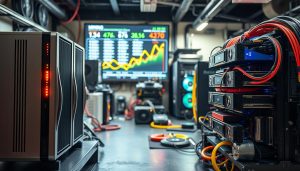
Bitcoin Mining: ASIC vs GPU – Which is Better?
Here’s something that shocked me: a single dedicated machine can outperform 50 graphics cards while
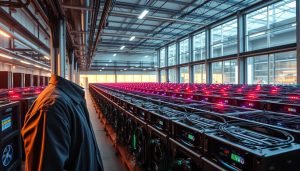
Bitcoin Mining Business for Sale: New Market Options
Here’s something that caught me off guard: the number of available bitcoin mining business for
XDC Price Shows Strong Momentum in Crypto Market Today
XDC cryptocurrency is making waves in the digital asset world. Its impressive market performance is catching investors’ eyes. The XDC price shows remarkable strength in
Etherscan: Your Gateway to the Ethereum Blockchain
Tracking over 700,000 active Ethereum addresses is now a breeze with Etherscan. This blockchain explorer has transformed our understanding of digital transactions1. With crypto trading
VWAP Trading Strategy Gains Traction on Wall Street
Wall Street is buzzing with a new trading strategy. The Volume Weighted Average Price (VWAP) indicator is changing the game for big investors. This sophisticated
 Bitcoin (BTC) $ 70,339.00
 Ethereum (ETH) $ 1,987.32
 Tether (USDT) $ 0.998333
 BNB (BNB) $ 682.97
 XRP (XRP) $ 1.27
 USDC (USDC) $ 0.999496
 Solana (SOL) $ 79.90
 TRON (TRX) $ 0.341901
 Lido Staked Ether (STETH) $ 2,265.05
 Figure Heloc (FIGR_HELOC) $ 1.04